I last remodeled a kitchen in Sumner where the homeowner had one ceiling light in the center of the room. One. A single flush-mount fixture from the 1980s, lighting a 12-by-14-foot kitchen. She cooked dinner in shadows every night, squinting at recipes, unable to tell whether chicken was done on the cutting board. That one fixture was doing the job of four.
I see this constantly. Most kitchens I walk into around Puyallup and Pierce County don’t have enough light. The homes went up in the 1960s or 1970s with one or two ceiling fixtures and maybe a fluorescent tube under a cabinet. Homeowners live with it for years because they assume lighting is a small fix. Sometimes it is. Sometimes it isn’t.
I want to give you honest numbers on what a kitchen lighting upgrade costs in 2026, what’s worth the money, and where the hidden expenses show up. No guessing. Real prices from real projects.
What Does a Kitchen Lighting Upgrade Cost in 2026?

The short answer: $800 to $5,000+ for most kitchen lighting projects in Pierce County. That range is wide because “lighting upgrade” means different things to different homeowners. Swapping out a couple of fixtures is a completely different job than rewiring a kitchen ceiling for 6 recessed cans.
Here’s how I break it down:
| Project Scope | What’s Included | Cost Range (Pierce County) |
|---|---|---|
| Basic fixture swap | Replace 2-3 existing fixtures with new ones, no new wiring | $400 - $1,200 |
| Add under-cabinet lighting | LED strip or puck lights under upper cabinets, new switch | $500 - $1,500 |
| Recessed lighting install | 4-6 recessed cans, new circuits, switch, drywall patching | $1,800 - $4,000 |
| Pendant lights over island | 2-3 pendant fixtures, new electrical box, wiring | $600 - $2,400 |
| Full kitchen lighting overhaul | Recessed cans + pendants + under-cabinet + dimmer controls | $3,500 - $8,000+ |
These prices include fixtures, electrical labor, materials, and basic finishing. They don’t include permit fees or any panel upgrades your home might need.
Labor in the Pacific Northwest runs 8-15% above the national average. If you’re comparing to numbers you found online from a contractor in Texas or Ohio, adjust up.
Where Your Money Goes: Fixture-by-Fixture Breakdown
Here’s what each type of kitchen lighting costs so you can see exactly where every dollar goes:
| Fixture Type | Fixture Cost | Installation Cost | Total Per Unit |
|---|---|---|---|
| Recessed can (LED) | $30 - $75 each | $150 - $250 each | $180 - $325 each |
| Pendant light | $150 - $600 each | $200 - $400 each | $350 - $1,000 each |
| Under-cabinet LED strip | $8 - $12/linear ft | $150 - $300 (total labor) | $200 - $500 total |
| Under-cabinet puck lights | $15 - $40 each | $150 - $300 (total labor) | $250 - $550 for a set of 4-6 |
| Flush-mount ceiling fixture | $50 - $250 | $100 - $200 | $150 - $450 |
| Track lighting (4-6 heads) | $100 - $400 | $150 - $300 | $250 - $700 |
| Dimmer switch | $25 - $80 | $75 - $150 | $100 - $230 |
The biggest cost driver isn’t the fixture itself. It’s the electrical work behind it. A $200 pendant light still needs $200 to $400 in labor to hang, wire, and connect to a circuit. If there’s no existing electrical box where you want that pendant, the electrician runs new wire through the ceiling, installs a junction box, and ties into a circuit. That’s where the hours go.
The Electrical Work Nobody Thinks About
This is the part that catches people off guard. Picking out fixtures is the fun part. The electrical work behind the walls and above the ceiling is where the real cost lives.
New circuits. Most lighting upgrades in older kitchens need at least one new dedicated 20-amp circuit. That runs $250 to $500 per circuit, including wire, breaker, and labor. If you’re adding 6 recessed cans, a set of under-cabinet LEDs, and pendant lights over the island, you might need 2 new circuits to handle the load without tripping breakers.
Electrical permits. Pierce County requires an electrical permit for any new circuits. The permit runs $85 to $150, and your electrician handles the paperwork. An inspector comes out after the rough-in wiring and again after everything is finished and connected. Budget an extra week in your timeline for the permit process.
Panel upgrades. This is the one that changes budgets overnight. A lot of homes in Puyallup, Lakewood, and Spanaway went up between the 1950s and 1970s with 100-amp or even 60-amp electrical panels. Those panels are already near capacity just running the existing loads. Adding new kitchen circuits might push past what the panel can handle, and a 200-amp panel upgrade costs $2,000 to $4,000. I’ve walked into kitchens where the homeowner wanted $1,500 in new lighting and the final number hit $4,500 because the panel couldn’t support it.
Drywall patching. Running new wires through finished ceilings and walls means cutting access holes. A good electrician minimizes the damage, but you’ll still need drywall repair and paint touch-up afterward. Budget $200 to $600 for patching, depending on how much wire the crew ran.
Here’s a checklist of hidden electrical costs to plan for:
- Dedicated circuits ($250-$500 each)
- Electrical permit ($85-$150)
- Panel capacity check (free with most electricians)
- Panel upgrade if needed ($2,000-$4,000)
- Drywall patching and paint ($200-$600)
- GFCI protection near wet areas ($25-$50 per outlet)
What I’m Installing the Most Right Now
Lighting trends in kitchens have shifted over the past few years. Here’s what my clients are actually picking in 2026.
Layered Lighting
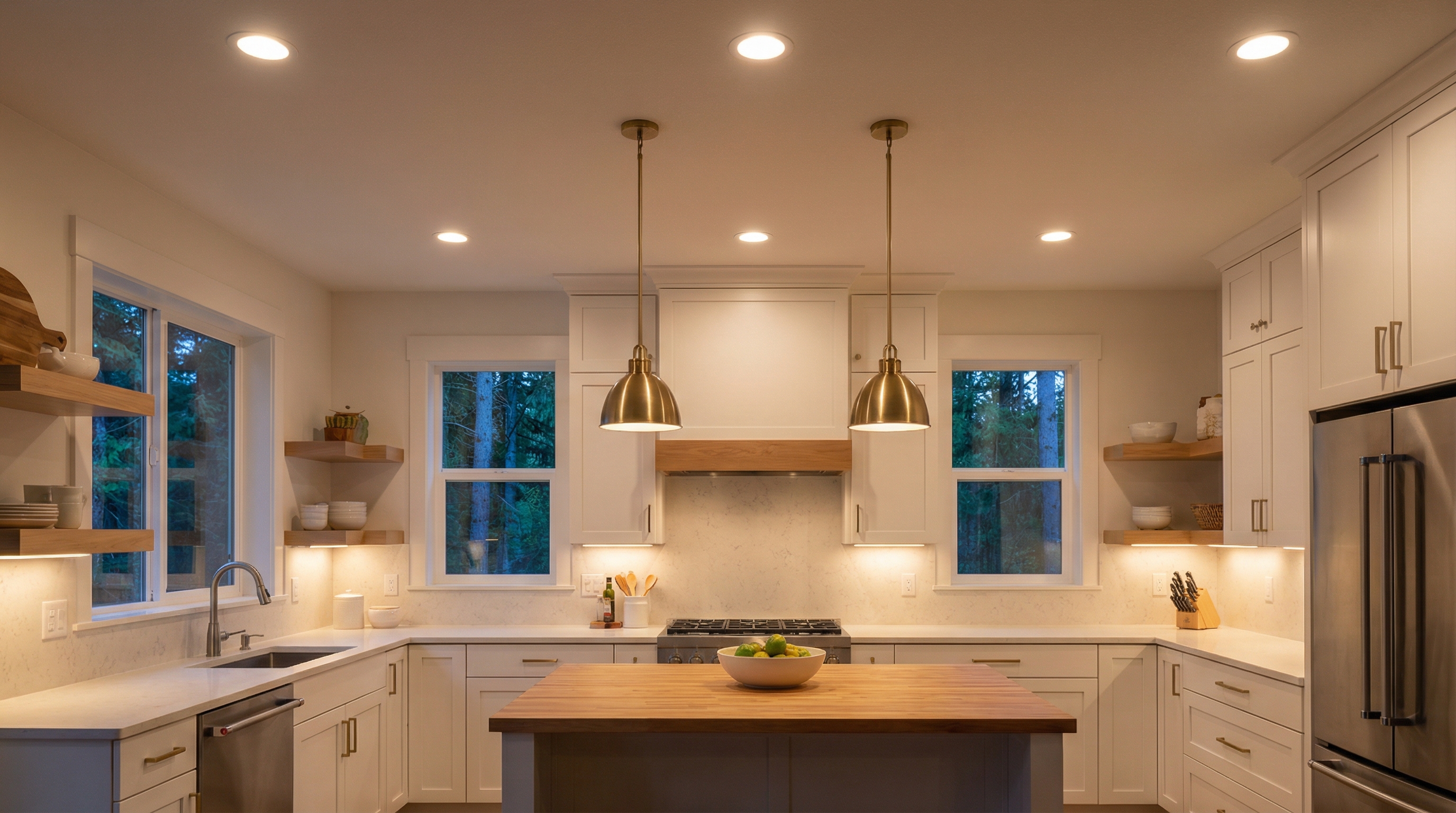
This is the single biggest improvement I push for in every kitchen remodel. Instead of one or two fixtures doing all the work, you layer three types of light:
- Ambient (recessed cans or flush-mount) for general room brightness
- Task (under-cabinet LEDs) for countertop work areas
- Accent (pendants over an island or dining nook) for visual interest and focused light
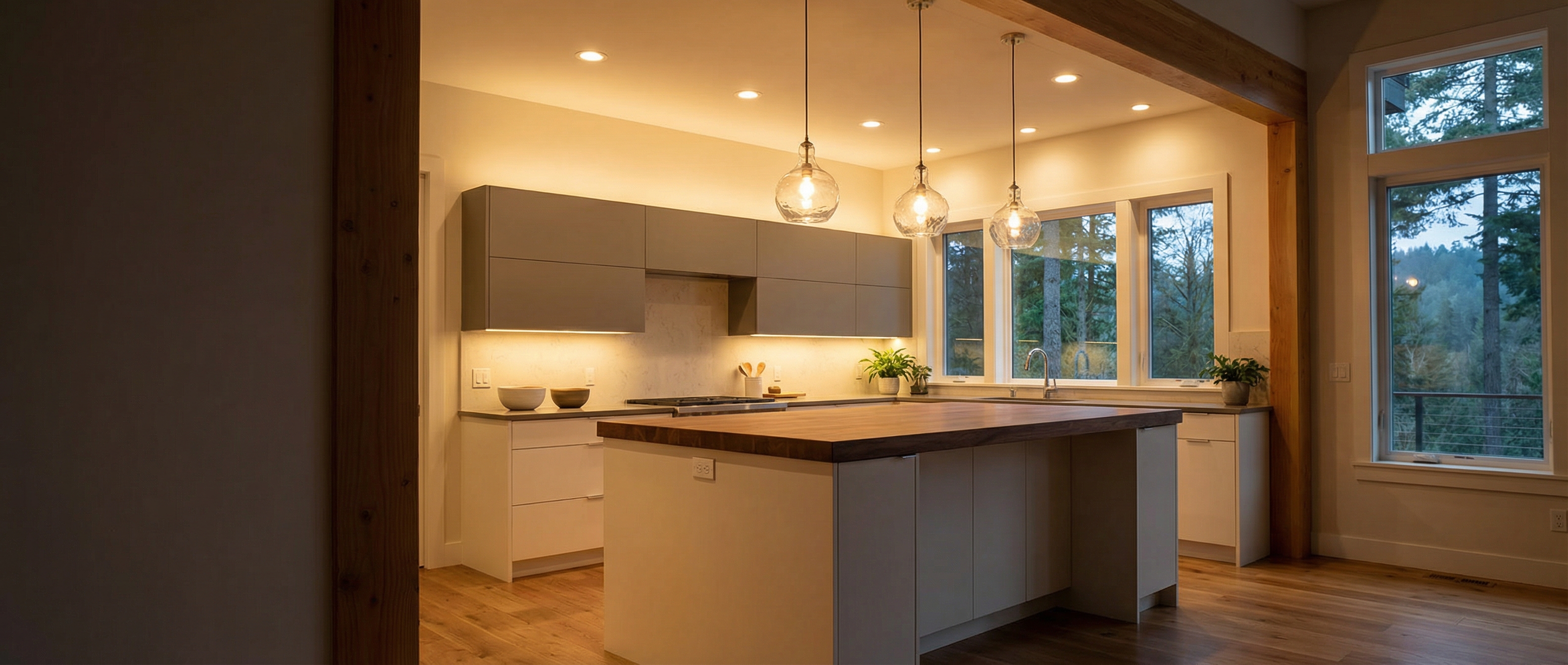
A kitchen with all three layers looks and functions completely differently than one with a single overhead fixture. The total cost for a full three-layer setup in a standard Pierce County kitchen runs $3,500 to $6,500.
Recessed LED Cans
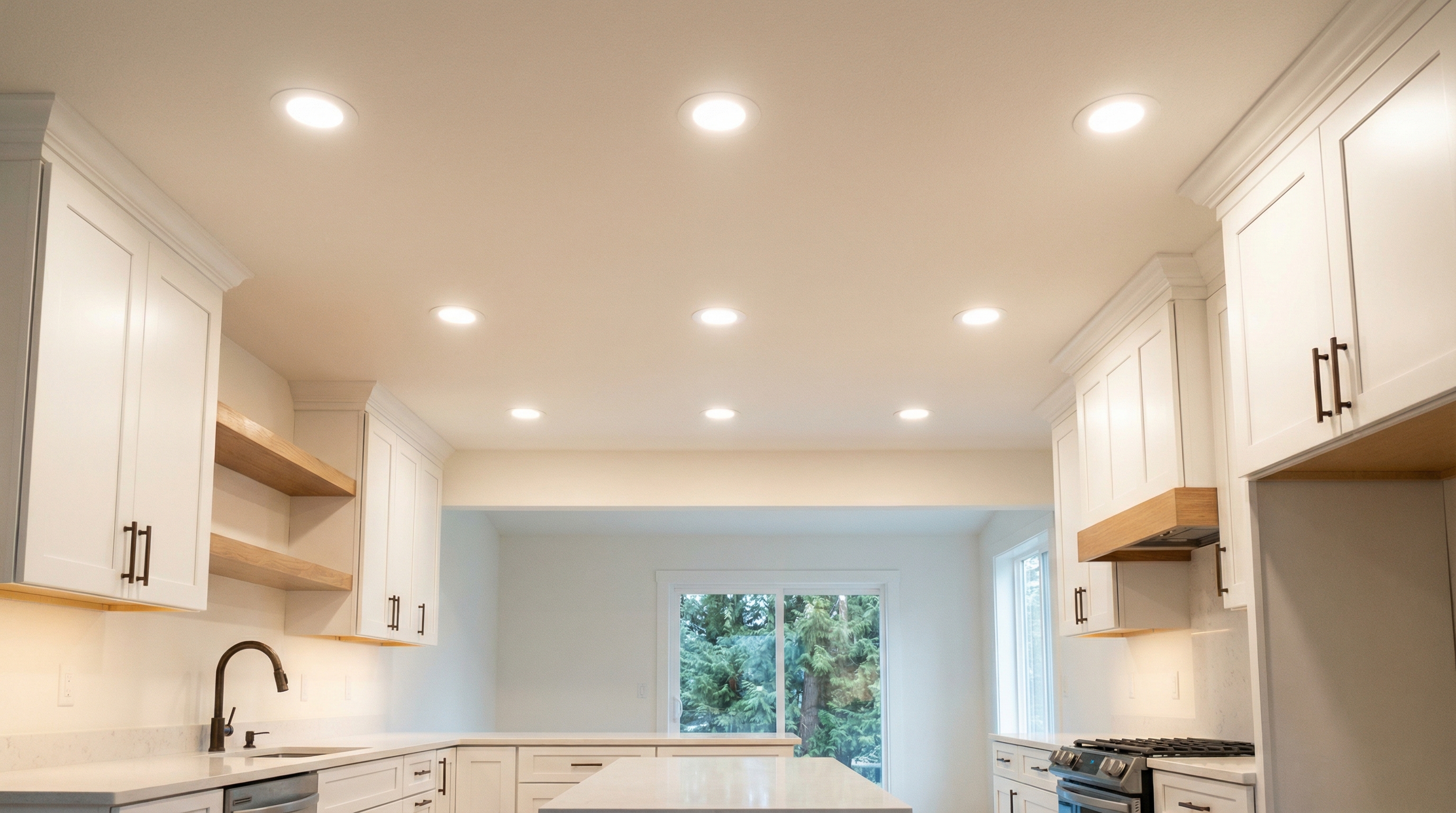
Recessed lighting is still the most requested fixture type I install. I use 4-inch and 6-inch LED recessed cans with integrated trim on the majority of my kitchen projects. LED modules last 50,000+ hours, use a fraction of the electricity, and throw clean, even light across the room.
For a typical 10-by-12 kitchen, I recommend 4 to 6 cans spaced about 4 feet apart and 2 feet from the walls. Total installed cost for that layout: $1,000 to $2,000.
Under-Cabinet LED Strips
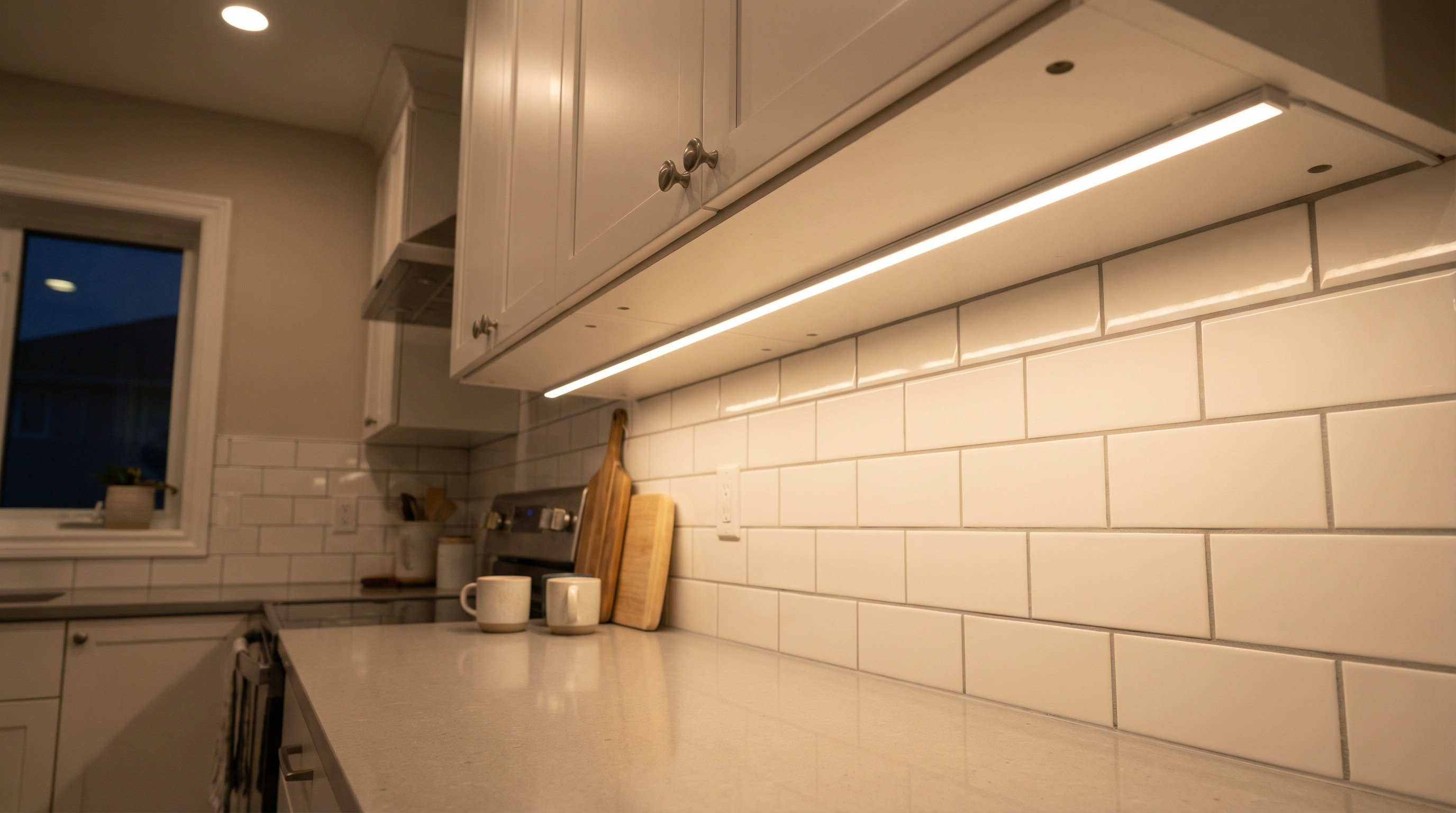
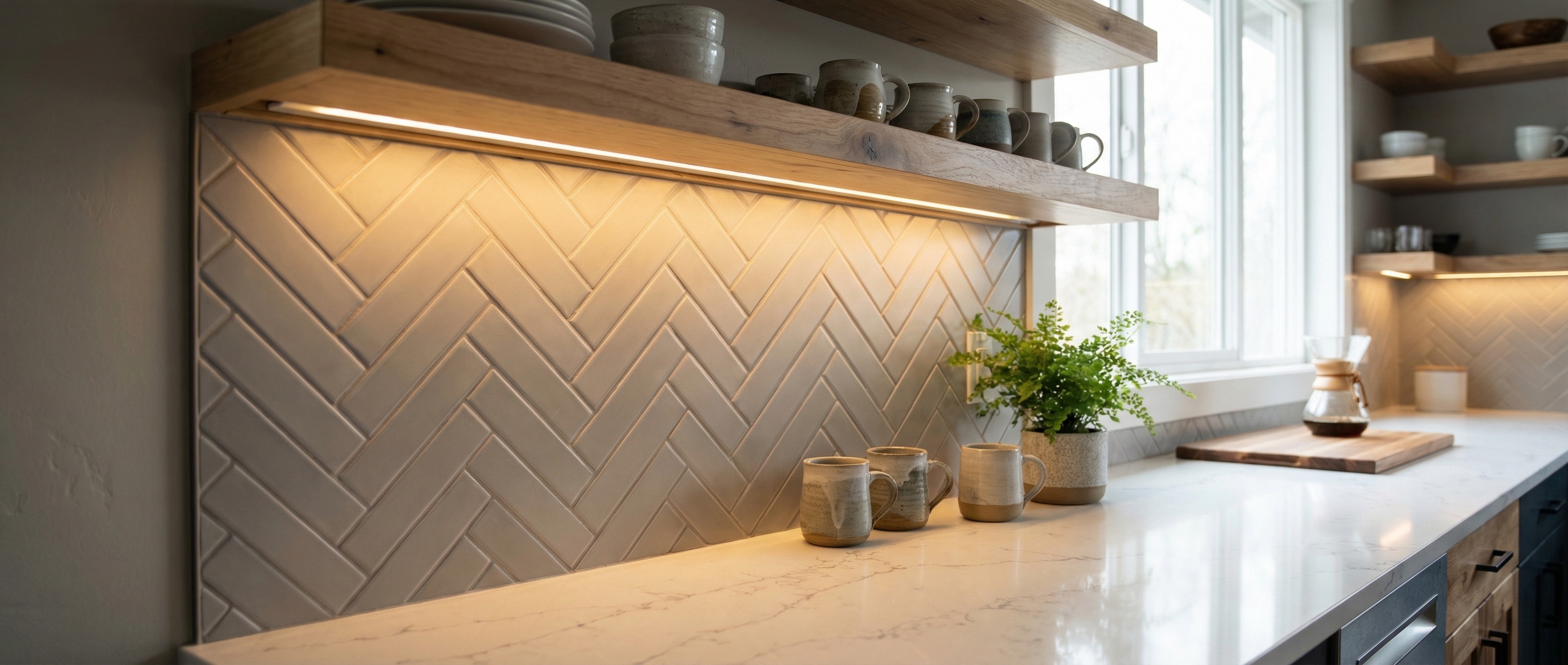
This is the single biggest bang-for-your-buck lighting upgrade in any kitchen. Period. A $200 to $500 install that changes how you use your countertops every day. No more chopping vegetables in your own shadow because the overhead light is behind you.
I use hardwired LED tape from WAC Lighting or GE Premium LED. Hardwired beats the plug-in adhesive strips from the hardware store in every way. Those adhesive strips peel off the cabinet in 6 months. The hardwired version ties into a dedicated switch and sits inside an aluminum channel under the cabinet face frame. Clean install, no visible wires, and it lasts for years.
Pendant Lights Over the Island
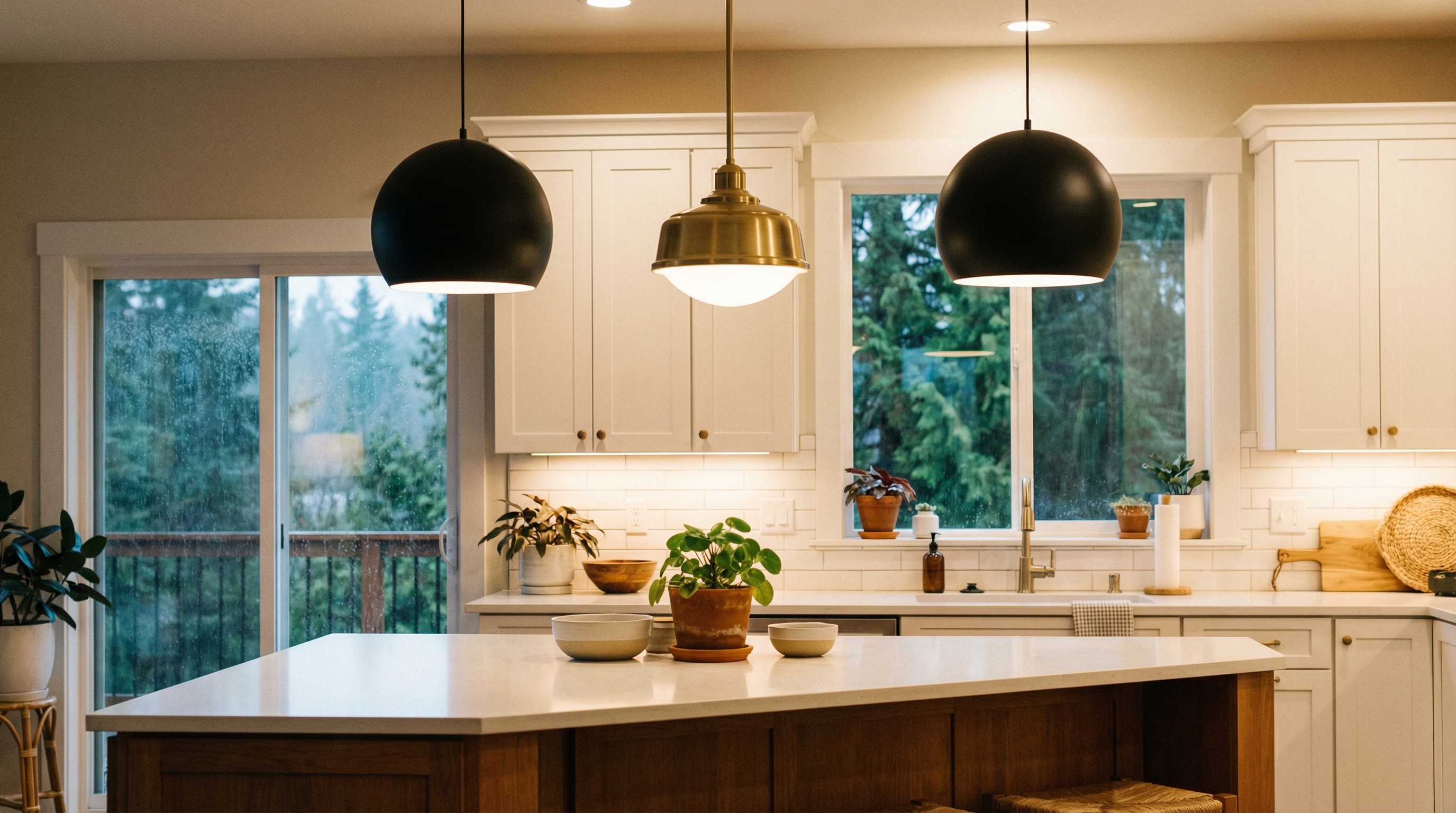
If you have a kitchen island, pendant lights above it are almost expected now. Two to three pendants hung 30 to 36 inches above the countertop is the standard spacing. I see a lot of matte black and brushed brass finishes right now. Globe shapes, schoolhouse shapes, and linear bar fixtures all show up regularly in Pierce County kitchens.
The fixture itself ranges from $150 to $600 each depending on brand and style. Kichler, West Elm, and Rejuvenation are popular picks locally. Installation adds $200 to $400 per fixture if there’s no existing electrical box above the island, and there usually isn’t in older homes.
Dimmer Controls
I put dimmers on every kitchen lighting circuit. No exceptions. A dimmer switch costs $25 to $80 for the hardware and $75 to $150 for the electrician to wire it. That $100 to $230 investment lets you go from full bright task lighting while you’re cooking to soft ambient light for dinner. It’s one of those small upgrades every homeowner tells me they should have done years ago.
Older Homes in Pierce County: Expect Surprises Behind the Walls

I work in a lot of 1950s through 1970s homes around Puyallup, Sumner, and Lakewood. These houses have their own set of challenges with lighting work.
Knob-and-tube wiring. Some pre-1950s homes still have knob-and-tube in parts of the house. You cannot tie new lighting circuits into knob-and-tube. The electrician has to replace it in whatever section you’re working in, and that adds $1,000 to $3,000 depending on how much rewiring the job requires.
Aluminum wiring. Homes built between roughly 1965 and 1975 sometimes have aluminum branch wiring. Aluminum requires special connectors (COPALUM or AlumiConn) when tying into copper circuits. Your electrician needs to know this before starting. Using the wrong connectors creates a fire risk.
Insulation contact. Running recessed cans in a ceiling with blown-in insulation above it requires IC-rated (insulation contact) fixtures. These cost a little more but code requires them. If the existing cans in your kitchen aren’t IC-rated and they sit buried in insulation, you need to replace them regardless of whether you planned on it.
Low ceilings. A lot of these older ranches have 7.5 to 8-foot ceilings. Pendant lights need 7 feet of clearance below them at minimum. In a kitchen with 8-foot ceilings and a 36-inch counter, that gives you about 12 inches of drop for the pendant. That limits your fixture options significantly. I steer homeowners toward flush-mount or semi-flush fixtures in low-ceiling kitchens and save the pendants for rooms with 9-foot ceilings or higher.
A Kitchen Lighting Project on South Hill: What It Actually Cost
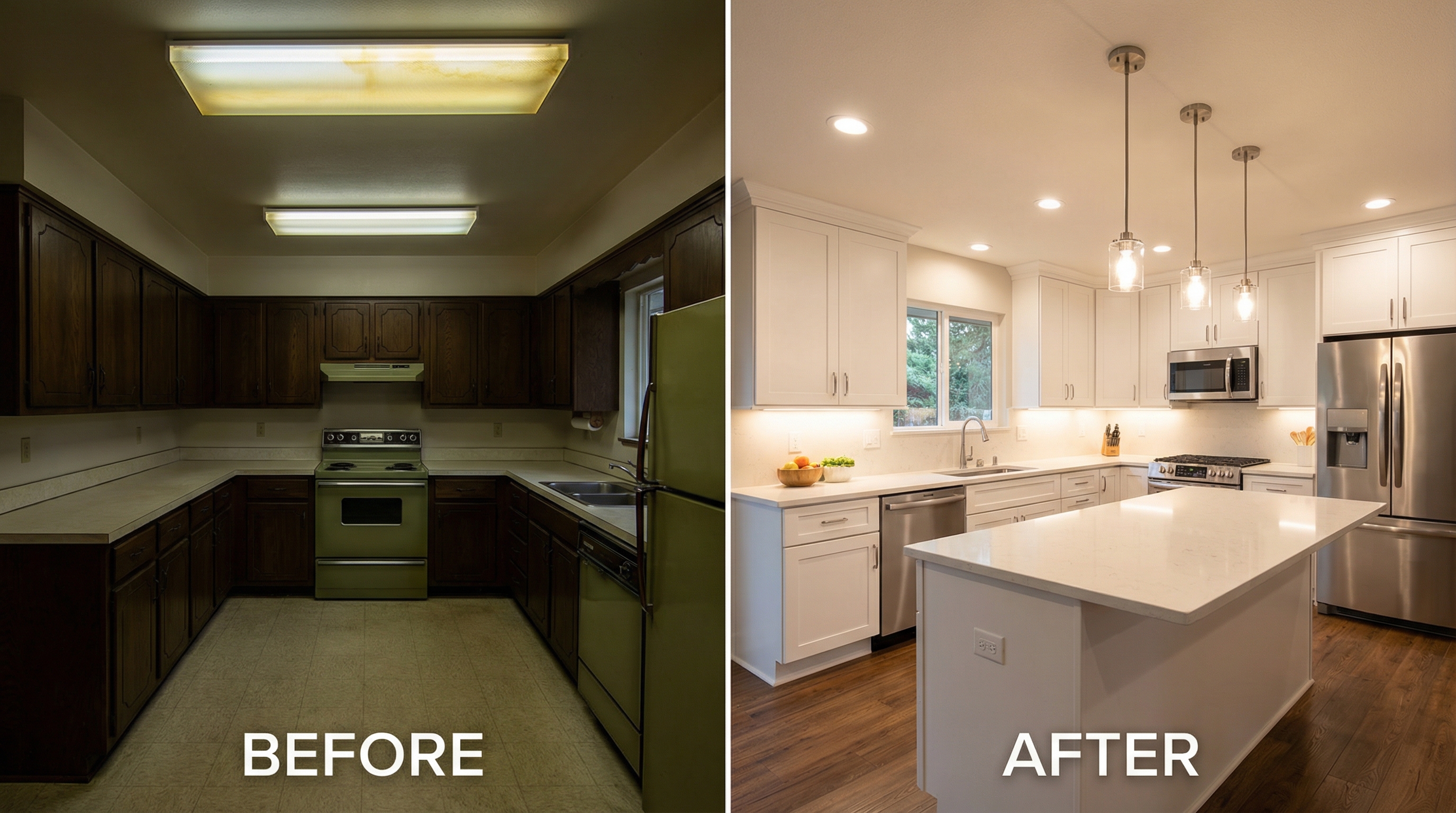
Last fall I did a lighting upgrade as part of a kitchen remodel in a 1972 split-level near South Hill. The homeowner’s original lighting was two fluorescent fixtures in the ceiling, both with yellowed plastic diffuser panels. Flat, dim, and dated. Here’s everything we did and the exact costs:
| Item | Qty | Cost |
|---|---|---|
| Remove old fluorescent fixtures | 2 | $150 |
| 6” recessed LED cans (fixture + install) | 6 | $1,500 |
| Under-cabinet LED strips (hardwired) | 12 linear ft | $450 |
| Pendant lights over island (Kichler Everly, fixture + install) | 3 | $1,050 |
| Dimmer switches | 3 | $375 |
| New 20A dedicated circuits | 2 | $700 |
| Electrical permit | 1 | $125 |
| Drywall patching and paint touch-up | , | $400 |
| Total | $4,750 |
Her original budget was $3,000. We landed at $4,750 because the job needed two new circuits, and the old fluorescent fixtures left discolored rectangles on the ceiling that required skim coating before paint. The panel had capacity, thankfully. If it hadn’t, we’d have added another $2,500 or more.
That $4,750 turned a kitchen that felt like a cave into the brightest room in the house. The under-cabinet LEDs alone changed how she used her countertops. Her words after the first evening: “I can actually see what I’m doing for the first time in 20 years.”
Worth every dollar.
Common Questions About Kitchen Lighting Upgrades
How long does a kitchen lighting upgrade take? A basic fixture swap takes half a day. Adding recessed lighting with new circuits takes 2 to 4 days. A full lighting overhaul with multiple fixture types, new circuits, permit, and patching takes about a week to 10 days including the inspection wait.
Do I need a permit to upgrade my kitchen lighting? In Pierce County, you need an electrical permit if you’re adding new circuits, moving electrical boxes, or installing fixtures where none existed before. Swapping an existing fixture for a new one on the same wiring does not require a permit. If you’re unsure, check with Pierce County or read our permit guide.
Can I add recessed lights if there’s a second floor above my kitchen? Yes, but placement gets trickier. The electrician works between the floor joists of the room above, which limits where cans can go. If the joists run the wrong direction for your layout, some spots won’t work. It’s doable in most homes, just requires more upfront planning.
Is LED lighting worth the higher upfront cost? LED is the only thing I install now. A LED recessed can uses about 10 watts versus 65 watts for the old incandescent version. Over a rated life of 50,000 hours, that adds up fast. The fixtures cost slightly more upfront, but the bulbs last 15 to 20 years and cut your kitchen lighting electricity use by roughly 80%.
How many recessed lights do I need in my kitchen? The general rule: one recessed can for every 4 to 6 square feet of floor space, placed on an even grid. A 120-square-foot kitchen typically needs 4 to 6 cans for solid coverage. I always draw a layout on paper before cutting any holes to avoid conflicts with cabinets, beams, and HVAC ductwork above the ceiling.
Should I upgrade my electrical panel before a lighting project? Not always. But if your home has a 100-amp panel that’s already close to full, adding 2 to 3 new circuits could push past its capacity. A licensed electrician can check your panel and tell you in 15 minutes whether you need an upgrade. Get this checked before you commit to a budget, because a panel upgrade adds $2,000 to $4,000 on top of everything else.
What’s the best lighting for above a kitchen sink? A single recessed can directly above the sink is the most practical choice. Some homeowners prefer a small pendant or wall sconce for style. Whatever you pick, put it on its own switch so you can use it as a night light without firing up every light in the kitchen.
Can I do kitchen lighting as a standalone project, or does it have to be part of a full remodel? Lighting is one of the few kitchen upgrades that makes sense on its own. You don’t need new cabinets or a new backsplash to get better light in your kitchen. I do standalone lighting projects regularly. It’s a fast, high-impact improvement that most homeowners notice the very first night.
Ready to Talk About Your Kitchen Lighting?
If you’re tired of cooking in a dim kitchen or you can’t see your countertops without turning on your phone flashlight, I’d like to walk through your space and show you what’s possible. Every kitchen is different, and the best way to get a real number is a free in-home visit where I can check your electrical panel, look at your ceiling, and talk about what matters most to you.
I’ve been in the trades for over 20 years and have served Puyallup and Pierce County since 2018. My crew and I treat every home like it’s our own. Contact us to schedule your free estimate, or call me at (253) 392-9266.
Brad Zemke Pacific Remodeling LLC Puyallup, WA