Last week I sat down with a couple in Bonney Lake who had been going back and forth on countertops for two months. They had a Pinterest board with 47 pins, half quartz and half granite, and they still couldn’t decide. The husband liked the look of natural granite. The wife wanted something low-maintenance. They asked me the same question I hear on almost every kitchen remodel consultation: “Brad, if this was your kitchen, which one would you pick?”
I’ve installed both materials in hundreds of kitchens across Pierce County since starting Pacific Remodeling in 2018. Before that, I spent 20-plus years in the trades working in climates from tropical Hawaii to arctic Alaska. I’ve seen how both quartz and granite hold up over time, in different conditions, with different families using them. So I’m going to give you the same answer I gave that couple, with all the real numbers and honest opinions that go with it.
Quartz vs. Granite at a Glance
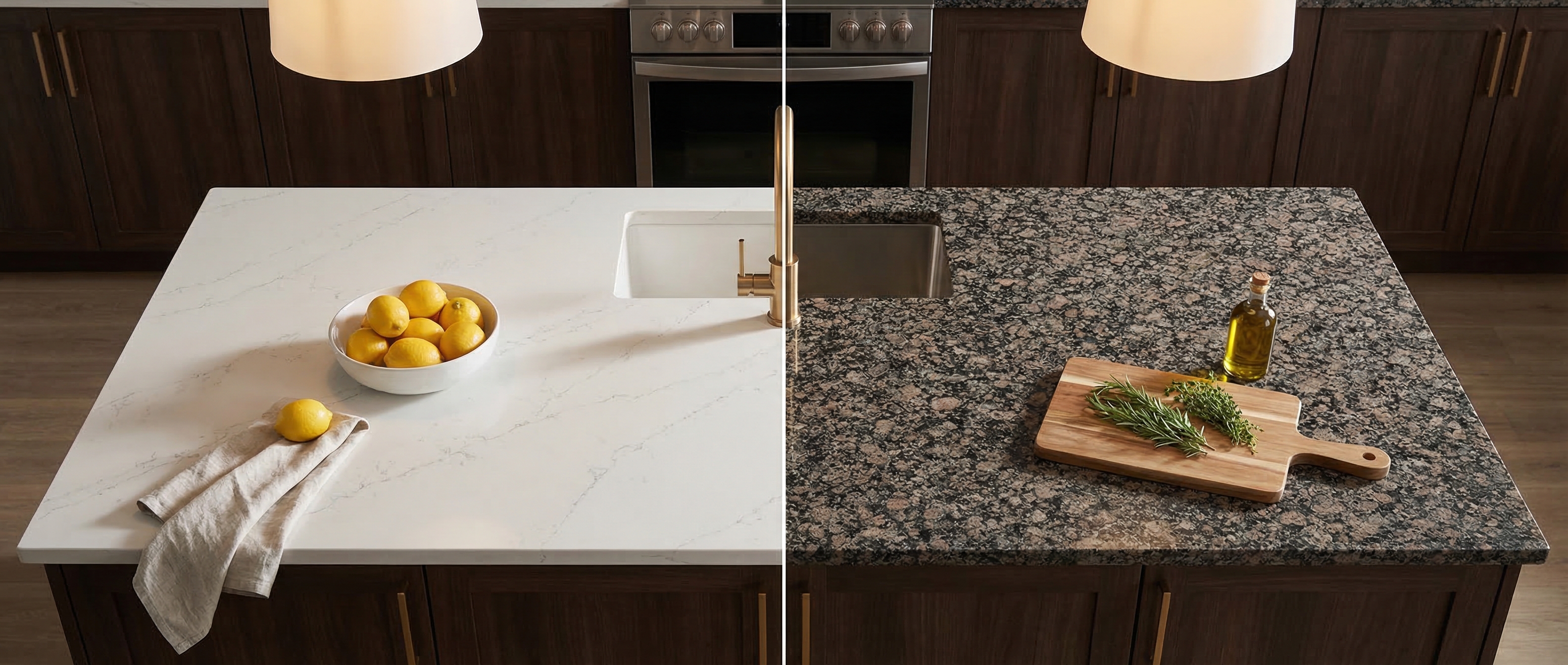
Before we get into the details, here’s the side-by-side comparison. These numbers reflect what I see on actual projects here in Pierce County, not national averages pulled from some database.
| Category | Quartz | Granite |
|---|---|---|
| Cost per sqft (installed) | $55 – $120 | $40 – $100 |
| Total kitchen cost (30-50 sqft) | $4,500 – $13,000 | $4,000 – $11,000 |
| Material cost per sqft | $40 – $80 | $30 – $60 |
| Fabrication + install per sqft | $15 – $40 | $15 – $40 |
| Durability | Extremely durable, resists chips | Very durable, can chip or crack |
| Maintenance | No sealing required | Seal once a year (15 minutes) |
| Heat resistance | Moderate, hot pans can damage | Excellent, handles heat well |
| Stain resistance | Excellent, non-porous | Good when sealed, porous if not |
| Appearance | Consistent patterns, wide color range | Every slab is unique, natural veining |
| Lifespan | 25-50+ years | 25-50+ years with proper care |
| Best for | Busy families, low maintenance | Homeowners wanting natural stone |
Both materials will last decades if you treat them right. The real differences come down to how you use your kitchen, how much maintenance you want to do, and what look you’re going for.
What Quartz Countertops Actually Are
A lot of homeowners think quartz countertops are slabs of natural quartz stone pulled from the earth. That’s not how it works. Quartz countertops are engineered stone. They’re manufactured by combining roughly 90 to 95 percent ground natural quartz with 5 to 10 percent polymer resins and pigments. The manufacturer mixes the quartz crystals with the binder, presses it into slabs, and cures it under heat and pressure.
This manufacturing process is what gives quartz its biggest advantages. Because a factory controls the process, the patterns and colors are consistent from slab to slab. If you pick a white marble-look quartz for your kitchen, the sample you see at the showroom will match what goes on your counters. Try doing that with natural stone and you’ll find that every single slab looks different.
Brands I Install
I work with several quartz manufacturers, and each one has its strengths:
Cambria is made in the USA, in Minnesota specifically. It’s one of the higher-end quartz brands, and you can feel the quality difference. Prices run $60 to $100 per square foot for the material alone. Their patterns, especially the marble-look options, are some of the most realistic I’ve seen in quartz.
Caesarstone is another premium brand with a strong reputation. Material costs run $55 to $85 per square foot. They pioneered the engineered quartz category and their quality control is tight.
Silestone offers a huge range of colors and patterns at $45 to $75 per square foot for material. They also have an antimicrobial protection built into the surface, which some homeowners like for kitchen applications.
MSI (Q Quartz) is the budget-friendly option that still delivers good quality. Material runs $40 to $60 per square foot. For homeowners watching their budget but still wanting quartz, MSI is where I steer them. The patterns won’t fool a stone expert, but for everyday use, they look great and perform well.
Where Quartz Shines
No sealing, ever. This is the number-one reason my clients choose quartz. Granite needs to be sealed once a year. Quartz doesn’t need sealing at all, because the resin binder makes the surface completely non-porous. Spill red wine on it, wipe it up, and you’re done. No panic about whether the seal has worn off.
Consistent appearance. When you pick a quartz pattern, you know exactly what you’re getting. If you need two slabs to cover your kitchen, they’ll match. I’ve had granite projects where the homeowner loved the first slab, and then the second slab from the same quarry looked noticeably different. That doesn’t happen with quartz.
Stain resistance. Because quartz is non-porous, it resists stains better than any natural stone. Coffee, wine, oil, tomato sauce, turmeric, all the usual kitchen suspects wipe right off. I’ve seen granite counters with permanent stain rings from olive oil bottles that sat in the same spot for months, and nobody thought to check whether the seal was still holding up.
Color and pattern range. You can get quartz in colors that don’t exist in nature. Pure white with no veining, solid black, bold blues, greens, concrete gray, or realistic marble looks with dramatic veining. If you have a specific design vision, quartz probably has a match for it.
Durability in daily use. Quartz scores a 7 on the Mohs hardness scale, which means it resists scratches from everyday kitchen use. It won’t chip as easily as granite either, because the resin binder gives it a slight flexibility that natural stone doesn’t have.
Where Quartz Falls Short
Heat sensitivity. This is the one I warn every client about. Don’t put hot pans directly on quartz. The resin binder can scorch or discolor at temperatures above 300 to 400 degrees Fahrenheit. Trivets and hot pads are a must. I’ve repaired quartz counters where someone set a cast iron skillet straight from the stove onto the surface and left a permanent heat mark. Granite handles that same scenario without flinching.
Sunlight can cause problems. If your kitchen has a section of countertop that sits in direct sunlight for hours every day, quartz can yellow or discolor over time. The UV rays break down the resin, and the color shifts. This is more of an issue with lighter-colored quartz, and it mainly affects countertops near large south-facing or west-facing windows. In most Pierce County kitchens, this isn’t a dealbreaker because our overcast climate limits extreme sun exposure. But if you have a sunroom with countertops, or a kitchen with a wall of windows, I’ll mention it during our consultation.
Not fully natural. Some homeowners want the real thing. They want stone that came out of the ground, with all the natural character that comes with it. Quartz, no matter how realistic the patterns look, is an engineered product. For some people, that matters. For most of my clients, it doesn’t.
Outdoor use is a no-go. If you’re thinking about putting quartz on an outdoor kitchen or BBQ area, don’t. The UV exposure and temperature swings will degrade the material. Granite or natural stone is the better call for outdoor applications.
Quartz Cost Breakdown
Here’s how the money breaks down on a typical quartz countertop project in a Pierce County kitchen. I’m using a 40-square-foot kitchen as the example, which is about average for the homes I work in.
Material cost: $40 to $80 per square foot, depending on brand and pattern. For 40 square feet, that’s $1,600 to $3,200.
Fabrication: This includes templating your kitchen (measuring everything with precision), cutting the slabs, polishing edges, and cutting sink and cooktop openings. Fabrication typically runs $10 to $25 per square foot. For 40 square feet: $400 to $1,000.
Installation: Getting the countertops into your kitchen and securing them to the cabinets. This runs $5 to $15 per square foot. For 40 square feet: $200 to $600.
Edge profiles: Standard eased or beveled edges are usually included. Upgraded edges like ogee, bullnose, or waterfall cost $10 to $30 per linear foot. A typical kitchen has 15 to 25 linear feet of exposed edge.
Sink cutout: Usually included in fabrication, but an undermount sink cutout and polish adds $150 to $300 if it’s not.
Backsplash: If you want a matching quartz backsplash, budget an additional $20 to $45 per square foot installed.
Total installed cost for a 40-sqft quartz kitchen: $3,500 to $8,500. Add upgraded edges or a quartz backsplash and you can easily reach $10,000 to $13,000.
Pro Tip: Always get your quartz quote with fabrication and installation included. Some showrooms quote material-only prices that look low, then tack on $2,000 to $3,000 in fab and install fees. I quote everything as one installed price so there are no surprises.
What Granite Countertops Actually Are
Granite is igneous rock. It formed millions of years ago when molten magma cooled slowly beneath the earth’s surface. The slow cooling process created the interlocking crystal structure that makes granite so hard and durable. Each slab contains a unique mix of minerals, primarily feldspar, quartz, and mica, and those minerals are what create the color patterns and veining that people love.
Every granite slab on earth is one of a kind. That’s not marketing language. It’s geology. The slab you see in the stone yard will never be duplicated because no two sections of the quarry produce the same mineral pattern. For some homeowners, this uniqueness is exactly what they want. For others, it’s a source of anxiety because you can’t guarantee the second slab will match the first.
Granite slabs are quarried from locations all over the world. Brazil, India, Italy, China, and several African nations produce most of the granite you’ll see in showrooms. Where the stone originates affects the price significantly. A common granite from Brazil might run $30 per square foot for the material, while a rare Italian or Brazilian exotic could hit $60 or more per square foot.
Where Granite Excels
Heat resistance. Granite handles heat better than any other common countertop material. You can set a hot pan directly on granite and it won’t scorch, discolor, or crack. For serious home cooks who are constantly moving pots and pans around, this matters. I still recommend using trivets as a general practice, but granite gives you a margin of error that quartz doesn’t.
Natural beauty. There’s something about a natural stone countertop that engineered materials can’t replicate, no matter how good the technology gets. The depth, the way light catches the mineral crystals, the movement in the veining, it’s real and it looks real. When you run your hand across a polished granite surface, you can feel the minerals under your fingertips. Every time I install a striking piece of granite, the homeowner’s reaction when they walk in and see it for the first time reminds me why people still choose natural stone.
UV resistance. Unlike quartz, granite won’t fade, yellow, or discolor in direct sunlight. If your kitchen has large windows that flood the counters with sun, or if you’re doing an outdoor kitchen, granite is the safer choice.
Uniqueness. Your kitchen won’t look like anyone else’s. Period. The slab you select is yours and yours alone. I take clients to the stone yard so they can hand-pick their exact slab, walk around it, see it wet and dry, and choose the sections they want highlighted in their kitchen. That experience is part of what people pay for.
Proven longevity. Granite countertops have been in homes for decades. We know exactly how they age. With proper sealing and basic care, a granite counter will outlast the kitchen around it. I’ve pulled granite countertops out of 30-year-old kitchens during remodels, and the stone itself was still in perfect condition.
Where Granite Falls Short
It’s porous. This is the biggest drawback. Granite has tiny pores in its surface that can absorb liquids if the sealant has worn off. Red wine, coffee, cooking oil, and acidic liquids like lemon juice can penetrate the surface and leave stains. The fix is simple, seal it once a year, but you have to actually do it. I’d estimate that half the granite stain complaints I see come from homeowners who forgot to reseal, or didn’t know they needed to.
Annual sealing is required. It takes about 15 minutes to seal your granite countertops. You buy a granite sealer for $15 to $25 at any hardware store, spray it on, let it sit for 10 minutes, wipe off the excess. It’s not difficult. But it is one more thing to remember, and some people just don’t want the maintenance commitment. Quartz eliminates this step entirely.
It can chip or crack. Granite is hard, but it’s also brittle at the edges. A heavy pot dropped on the corner of a granite counter can chip it. A hard impact in the right spot can crack the slab. Chips can be repaired with epoxy and color-matched filler, but it’s never truly invisible. In 20-plus years, I’ve seen more chipped granite edges than I can count. Quartz’s resin binder gives it just enough flex to absorb impacts that would chip granite.
Slab matching is unpredictable. If your kitchen needs more than one slab, matching them can be tricky. Even slabs from the same block at the quarry can look different. I always take clients to the stone yard so we can lay out the slabs and plan the seams before fabrication, but it’s still a reality of working with natural stone.
It’s heavy. Granite slabs weigh roughly 18 to 20 pounds per square foot at a standard 3cm thickness. A 40-square-foot kitchen’s worth of granite weighs around 750 to 800 pounds. Your cabinets need to support that load, and installation requires a crew that knows how to handle heavy stone safely. This generally isn’t a cost issue since installation labor is similar to quartz, but it’s worth knowing that you can’t DIY a granite install with a buddy and a pickup truck.
Granite Cost Breakdown
Using the same 40-square-foot kitchen example:
Material cost: $30 to $60 per square foot. Common granites like Uba Tuba, New Venetian Gold, or Santa Cecilia sit at the lower end around $30 to $40 per square foot. Mid-range options like Alaska White, Colonial White, or Blue Pearl run $40 to $50. Exotic granites like Typhoon Bordeaux, Patagonia, or Van Gogh push $50 to $60 or higher. For 40 square feet: $1,200 to $2,400.
Fabrication: $10 to $25 per square foot, same as quartz. For 40 square feet: $400 to $1,000.
Installation: $5 to $15 per square foot. For 40 square feet: $200 to $600.
Edge profiles: Standard edges are typically included. Upgraded profiles cost $10 to $30 per linear foot, same as quartz.
Sealer (ongoing): $15 to $25 per year. Not a big expense, but it is an annual commitment.
Total installed cost for a 40-sqft granite kitchen: $2,800 to $7,000. Exotic granites with upgraded edges can push past $9,000 to $11,000.
Bottom Line: At the entry level, granite saves you $400 to $600 on a 40-square-foot kitchen compared to quartz. That difference matters when you’re stretching a remodeling budget across cabinets, flooring, and appliances.
Here’s the thing a lot of comparison articles won’t tell you: at the entry level, granite is genuinely cheaper than quartz. If budget is your primary concern and you’re comparing a basic granite like Uba Tuba at $40 to $45 per square foot installed against even an affordable quartz at $55 to $65 per square foot installed, the granite saves you $600 to $1,000 on a 40-square-foot kitchen. That difference matters to a lot of the families I work with.
My Recommendation (and Why 70% of My Kitchens Get Quartz)
I’m going to be straight with you. Over the last few years, roughly 70 percent or more of the kitchen remodels I complete use quartz countertops. That number has shifted steadily upward since I started Pacific Remodeling. In 2018, it was closer to 50-50. Today, quartz dominates, and there are good reasons for that shift.
For Most Pierce County Families: Quartz
If you cook regularly, have kids, don’t want to think about annual sealing, and want a countertop that just works without fuss, quartz is my recommendation. The non-porous surface means you don’t stress about spills. The consistent patterns mean you get exactly what you picked at the showroom. The durability holds up to daily family use without chipping at the edges.
I had a client in South Hill with three kids under eight. They chose a white quartz with subtle gray veining. I saw them at the grocery store about a year after the install, and she told me the counters still looked brand new even though her kids eat breakfast and do art projects on them every morning. That’s the kind of feedback that reinforces my recommendation.
For the average countertop project in a Pierce County kitchen, I’m quoting mid-range quartz at $65 to $85 per square foot installed. On a 35-square-foot kitchen, that puts the countertop portion of the project at $2,275 to $2,975. That’s a predictable cost for a material that won’t need any maintenance beyond wiping it down.
For the Natural Stone Lover: Granite
Some homeowners walk into the stone yard, see a slab of Typhoon Bordeaux or Blue Bahia, and they’re done. Nothing else will do. I get it. When a granite slab speaks to you, quartz patterns feel flat by comparison. If you want that one-of-a-kind natural look and you don’t mind spending 15 minutes once a year on sealing, granite will make you happy for decades.
I also recommend granite for homeowners doing an outdoor kitchen or BBQ area. The UV stability and heat resistance make granite the clear winner for any application where the countertop sees direct sunlight and extreme temperatures.
For Budget-Conscious Projects: Take a Hard Look at Granite
If you’re stretching your remodeling budget and the countertops need to come in lean, entry-level granite is hard to beat. Uba Tuba, a dark green-black granite with gold flecks, is one of the most affordable natural stones available. At $40 to $50 per square foot installed, it’s $10 to $15 per square foot cheaper than comparable quartz options. On a 40-square-foot kitchen, that’s $400 to $600 in savings that you can redirect toward cabinets, flooring, or appliances.
I’ve used Uba Tuba and New Venetian Gold on dozens of budget-focused kitchen remodels, and the homeowners love the results. These aren’t “cheap-looking” granites. They’re classic patterns that have been popular for 20-plus years because they work with a wide range of cabinet colors and kitchen styles.
Living in the Pacific Northwest Changes the Equation
Here’s something specific to our area that most national comparison guides skip entirely. We live in the Pacific Northwest. Our kitchens deal with conditions that a kitchen in Arizona or Texas doesn’t.
Moisture and Humidity
Pierce County gets roughly 40 inches of rain a year. Our indoor humidity levels run higher than drier regions, especially during the fall and winter months when we’re running heaters and drying wet coats in the mudroom. That ambient moisture affects countertop surfaces differently depending on the material.
Quartz’s non-porous surface gives it a real advantage here. Moisture can’t penetrate the surface, period. There’s no risk of moisture working its way into micro-pores and causing discoloration or bacterial growth over time. I’ve seen granite countertops in older PNW kitchens where the seal wore off around the sink, and moisture created dark spots in the stone that were difficult to remove even after resealing.
Granite performs just fine in our climate if you keep up with annual sealing. But the reality is that the PNW environment is less forgiving if you forget. In a dry climate, skipping a year of sealing might not cause visible problems. In our damp climate, the consequences show up faster.
Our Limited Sun Exposure Works in Quartz’s Favor
One of quartz’s known weaknesses is UV sensitivity, and that weakness matters a lot less in Pierce County than it does in southern California or Florida. We get roughly 150 sunny days per year. The intense, prolonged direct sunlight that causes quartz to yellow or discolor is rare here. I’ve installed quartz counters next to large windows in Puyallup homes, and after several years, the homeowners haven’t reported any discoloration at all.
This is a case where our local climate actually eliminates one of the material’s biggest drawbacks. A homeowner in Scottsdale might need to think twice about white quartz near a window. A homeowner in Puyallup doesn’t need to worry nearly as much.
Local Insight: Pierce County’s overcast climate neutralizes quartz’s UV weakness. I’ve installed white quartz next to large windows in Puyallup homes with no yellowing after several years.
What I’ve Seen Behind the Walls
I’ve pulled out old countertops in PNW kitchens that had water damage underneath, not from plumbing leaks, but from years of condensation and moisture accumulation in a climate that just stays damp. The countertop material itself wasn’t the cause. The issue was typically inadequate sealing between the counter and the backsplash or around the sink cutout. This is why proper installation matters as much as material selection. Regardless of whether you choose quartz or granite, the installation needs to account for moisture management, and any experienced PNW contractor will address this during the build. For more on choosing materials for our climate, read my guide to choosing remodeling materials.
Common Questions About Quartz and Granite
Is quartz more expensive than granite?
On average, yes. Quartz runs $55 to $120 per square foot installed, while granite runs $40 to $100 per square foot installed. But the ranges overlap significantly in the middle. A mid-range quartz like Silestone at $70 per square foot and a mid-range granite like Colonial White at $65 per square foot are only $5 apart. The real price gap appears at the entry level, where basic granite is $15 to $20 per square foot cheaper than basic quartz. And at the premium end, exotic granite can actually exceed high-end quartz in cost, so the “granite is always cheaper” assumption doesn’t hold across the board.
Which material is more durable?
Both are extremely durable, but they handle different types of abuse differently. Quartz is better at resisting scratches and stains because the resin binder creates a harder, non-porous surface. Granite is better at resisting heat because it’s natural stone that formed under extreme temperatures deep in the earth. For edge chips, quartz has a slight advantage because its resin content gives it a bit of flex that absorbs impacts better. Granite’s crystalline structure makes it more brittle at thin edges and corners. For everyday family kitchen use, I’d give quartz a slight edge in overall durability, mainly because of the stain resistance advantage.
How much maintenance does each material require?
Quartz requires almost zero maintenance. Clean it with soap and water or a mild household cleaner. That’s it. No sealing, no special products, no annual rituals. Granite requires sealing once a year, which takes about 15 minutes and costs $15 to $25 for a bottle of sealer. Between sealings, you clean it the same way as quartz. The daily cleaning is identical, but granite adds that one annual step. Some homeowners genuinely don’t mind it. Others want the lowest-maintenance option available, and that’s quartz.
Does quartz or granite add more resale value?
Both materials add strong resale value, and most real estate agents I’ve talked to in the Pierce County market consider either one a selling point. Neither one will hurt your home’s value. That said, quartz has become the more popular choice among younger buyers, and many real estate agents tell me that quartz countertops are now a “expected upgrade” in kitchens priced above $400,000 in our area. Granite still has strong appeal, especially exotic or unique slabs that give a kitchen character. If your primary goal is resale value, both are solid choices. I wouldn’t pick one over the other based on resale alone.
Can a hot pan really damage quartz?
Yes. I’ve seen it firsthand. The resin binder in quartz can scorch at temperatures above 300 to 400 degrees Fahrenheit. A cast iron skillet that was just on the burner, a hot baking sheet pulled from a 450-degree oven, a curling iron left on the counter, all of these can leave marks on quartz. The marks are typically white or yellowish discoloration that won’t wipe off. Some can be buffed out by a professional, but severe heat marks may require replacing that section of countertop. Always use trivets and hot pads. This is the one area where granite wins without any debate.
What edge profiles work best, and do they affect cost?
Standard edge profiles like eased (a simple slightly rounded square edge) and beveled (an angled cut on the top edge) are usually included in the fabrication cost for both quartz and granite. Upgraded edges like ogee (an S-curve profile), bullnose (a fully rounded edge), or waterfall (where the countertop material continues down the side of the island to the floor) add $10 to $30 per linear foot. For a kitchen with 20 linear feet of exposed edge, that’s $200 to $600 for the upgrade. Both materials can be fabricated with any edge profile. I generally recommend eased or beveled edges for families with young kids because the sharper decorative profiles like ogee can concentrate force on a small point if a child bumps into it.
Can I install quartz or granite countertops myself?
I wouldn’t recommend it. Here’s why. A standard 3cm countertop slab weighs 18 to 20 pounds per square foot. A 6-foot section of counter weighs around 200 pounds. You need proper equipment to transport and set the slab without cracking it, a crew experienced enough to handle that weight safely, and the skills to template accurately, make precise cutouts for sinks and cooktops, and create tight seams between slabs. Fabrication requires specialized CNC equipment or diamond-blade saws that you won’t find at a rental center. A bad cut means a ruined slab and $1,000 or more down the drain. I’ve been called in to fix DIY countertop attempts that cost the homeowner more than a professional install would have from the start. The money you think you’re saving on labor gets eaten up by mistakes, and the result never looks as clean.
How long do quartz and granite countertops last?
Both materials last 25 to 50 years or more with proper care. I’ve seen granite countertops still looking great after 30 years in homes where the owner kept up with sealing. Quartz hasn’t been on the market quite as long as granite, but the material science behind it suggests a similar or longer lifespan since there’s no sealing to forget and no pores to worry about. In practical terms, either material will outlast your cabinets, your appliances, and probably your interest in the current kitchen design. Most of my clients remodel their kitchens again in 15 to 20 years because their tastes change, not because the countertops wore out.
Do quartz or granite countertops harbor bacteria?
Quartz’s non-porous surface doesn’t allow bacteria to penetrate or grow within the material. Wipe it clean and the surface is sanitary. Granite, when properly sealed, also resists bacterial growth on the surface. But if the seal wears down, the pores in granite can technically harbor bacteria in the micro-crevices. For kitchens where food safety is a high priority, like homes with young children or anyone with a compromised immune system, quartz offers a slight advantage because you don’t have to rely on a sealant staying intact for the antibacterial benefit.
Picking the Right Countertop for Your Kitchen
Here’s how I walk clients through the decision. I ask three questions.
Question one: How do you use your kitchen? If you cook heavily, if you have kids making messes, if you want to be able to spill red wine during a dinner party and laugh it off instead of panicking, quartz is your answer. If you’re a serious home cook who puts hot pans down constantly and wants the counter to handle it without trivets, granite deserves a close look.
Question two: How do you feel about maintenance? If the idea of annual sealing annoys you, even though it only takes 15 minutes, go with quartz. If you’re the type of person who already has a home maintenance calendar and enjoys taking care of your house, granite’s annual sealing won’t bother you at all.
Question three: What look do you want? If you want a specific, consistent pattern that matches your design vision perfectly, quartz gives you that control. If you want a surface that’s truly unique, with natural variation that no factory can replicate, and you’re willing to visit the stone yard to hand-pick your slab, granite delivers that experience.
Most of the time, those three questions make the decision clear within a few minutes. And here’s the good news: there isn’t a wrong answer. Both materials are excellent choices that will serve your family well for decades. I install both with the same level of care and precision, and I’m confident in recommending either one depending on your specific situation.
How the Countertop Project Fits Into a Full Kitchen Remodel
Countertops don’t exist in a vacuum. They connect to cabinets below, backsplash behind, and your sink and cooktop cut through them. If you’re doing a full kitchen remodel, the countertop selection happens after cabinet selection because the cabinets need to be installed first, then templated for precise countertop measurements.
Here’s the typical timeline for just the countertop portion of a kitchen remodel:
- Cabinet installation (completed first)
- Template day (fabricator measures your installed cabinets, usually takes 1-2 hours)
- Fabrication (7-14 business days for the shop to cut, polish, and prepare your slabs)
- Installation day (usually half a day for a standard kitchen)
Total time from template to installed counters: 2-3 weeks. If you’re ordering a popular quartz pattern that’s in stock, it can be faster. If you’re waiting on a specific granite slab to be shipped from overseas, it could take 4-6 weeks.
I coordinate all of this as part of the overall kitchen remodel schedule, so the countertop timeline fits into the bigger picture without creating dead time in your project. Plumbing rough-in happens before counters go in, and the final plumbing connections (hooking up your sink and dishwasher) happen the same day or the day after installation.
Why Material Selection Matters Beyond the Surface
I’ve spent 20-plus years in the trades, and one thing I’ve learned is that the materials you choose set the tone for the entire project. A countertop isn’t just a surface where you prep food. It’s the most visible horizontal surface in your kitchen. It catches the light. It frames your sink. It anchors your island. People lean on it during parties, kids do homework on it, and it’s one of the first things buyers notice when they walk into a kitchen.
Choosing the right material isn’t about finding the cheapest option or following the latest trend. It’s about matching the material to how your family lives. I’ve seen homeowners pick gorgeous white marble-look quartz and then stress about every spill because they didn’t realize how low-maintenance quartz actually is, they just assumed all light countertops stain easily. I’ve also seen homeowners pick dark granite and then realize they wish they’d gone with a lighter quartz because the dark stone made their smaller kitchen feel even smaller.
That’s why I bring sample slabs to your kitchen during the consultation. Seeing a 4-inch square sample under showroom lighting tells you almost nothing about how the material will look in your space. But laying a full-size sample across your existing counter, under your kitchen lights, next to your cabinet color, that gives you real information to make a confident decision.
Ready to See the Options in Your Kitchen?
If you’re planning a kitchen remodel or just upgrading your countertops, I’d like to help you make the right call for your home. I’ll bring quartz and granite samples to your kitchen so you can compare them in your own lighting, against your own cabinets, with your own eyes.
No pressure. No sales pitch. Just an honest conversation about what works for your kitchen, your family, and your budget.
Call me at (253) 392-9266 or visit our contact page to schedule a free estimate. I serve homeowners across Pierce County, including Puyallup, Tacoma, Bonney Lake, Sumner, South Hill, and Edgewood.
I’ll bring sample slabs to your kitchen so you can see the materials in your own lighting. That’s how you make a decision you’ll be happy with 10 years from now.