A woman in Sumner called me last year with a simple question: “How do I even start planning a kitchen remodel?” She’d been staring at her 1992 oak cabinets and linoleum floors for six years, wanting to change everything but not knowing which step came first. Budget? Layout? Contractor? Countertops? The whole thing felt overwhelming, so she kept putting it off.
I hear this every week. And after 20+ years in the trades and running Pacific Remodeling since 2018, I’ve learned that the planning phase is where most kitchen projects either succeed or go sideways. A well-planned kitchen remodel finishes on time and on budget. A poorly planned one turns into a 4-month headache with $15,000 in change orders.
This guide walks you through every step of planning a kitchen renovation in the Puyallup area. Real numbers. Real timelines. No fluff.
Start With Your Budget (and Be Honest About It)
Before you pick a single cabinet color or browse Pinterest for backsplash ideas, you need to know what you can actually spend. Not what you hope it costs. What your bank account and financing will support.
Here’s what kitchen remodels cost in Pierce County right now:
| Project Scope | Cost Range (2026) | Typical Timeline |
|---|---|---|
| Cosmetic refresh (paint, hardware, countertops) | $15,000 - $30,000 | 2-4 weeks |
| Mid-range remodel (new cabinets, countertops, flooring, appliances) | $45,000 - $75,000 | 6-10 weeks |
| High-end full remodel (layout changes, custom cabinets, premium finishes) | $75,000 - $120,000+ | 10-16 weeks |
| Major structural (wall removal, addition, full reconfiguration) | $100,000 - $150,000+ | 12-20 weeks |
I tell every client: take your number and add 15-20% for surprises. Because there will be surprises. I’ve opened up walls in Puyallup homes built in the 1960s and found knob-and-tube wiring, galvanized pipes that were 80% corroded, and rot behind perfectly fine-looking drywall. You can’t predict what’s behind the walls until demo day. A contingency fund keeps those surprises from derailing your project.
Where Your Kitchen Budget Actually Goes
Most homeowners have no idea how the money breaks down. Here’s a realistic allocation for a mid-range kitchen remodel in our area:
| Category | Percentage of Budget | Dollar Range |
|---|---|---|
| Cabinetry and hardware | 30-35% | $13,500 - $26,250 |
| Countertops | 10-15% | $4,500 - $11,250 |
| Appliances | 10-15% | $4,500 - $11,250 |
| Labor and installation | 20-25% | $9,000 - $18,750 |
| Flooring | 5-8% | $2,250 - $6,000 |
| Lighting and electrical | 5-7% | $2,250 - $5,250 |
| Plumbing | 3-5% | $1,350 - $3,750 |
| Backsplash | 2-4% | $900 - $3,000 |
| Contingency | 15-20% | $6,750 - $15,000 |
Cabinets eat the biggest chunk. That’s why the refacing vs. replacing decision matters so much. If your boxes are solid, refacing saves you $8,000 to $17,000 that you can redirect toward countertops, appliances, or flooring.
For a deeper look at what drives kitchen remodel costs in our market, check my complete kitchen remodel cost breakdown.
Build Your Planning Timeline
Most people think a kitchen remodel starts when the contractor shows up with a sledgehammer. It doesn’t. The planning phase before construction takes 4 to 12 weeks depending on complexity, and rushing it creates problems that cost real money later.
Here’s the timeline I walk my clients through:
Weeks 1-2: Research and goal setting. Figure out what you want. What bothers you about your current kitchen? What would make it work better? Do you need more counter space, better storage, updated appliances, a different layout? Browse photos. Visit showrooms. Write down your priorities.
Weeks 2-4: Contractor selection. Get 3 bids. Compare scope, not just price. The cheapest bid usually leaves things out. I’ve seen homeowners pick the lowest number, then get hit with $12,000 in change orders because the contractor’s original estimate didn’t include electrical upgrades, permit fees, or demo disposal. Compare apples to apples. Read my section below on choosing a contractor.
Weeks 3-6: Design finalization. Work with your contractor on the layout, material selections, and detailed plan. This is where you decide on cabinets, countertops, flooring, backsplash, fixtures, and appliances. Every “I’ll decide later” during this phase adds days to your construction timeline.
Weeks 4-8: Material ordering. Custom cabinets take 4-8 weeks to arrive. Specialty tile can take 3-6 weeks. Appliances that are out of stock might take even longer. The order has to go in early, or your project stalls mid-construction while everyone waits for materials.
Weeks 6-10: Permits and scheduling. Your contractor pulls permits (required in Puyallup for any work involving plumbing, electrical, or structural changes). They schedule the crew, the subcontractors, and the inspections. Then construction begins.
The biggest planning mistake I see? Homeowners who skip the design finalization step. They tell me “just start and I’ll pick the backsplash later.” Then construction reaches the backsplash stage, they haven’t chosen tile, and the crew sits idle for a week while we wait. That idle time costs money.
Design Choices That Actually Matter
I’ve remodeled hundreds of kitchens. Some design decisions affect how you use the space every single day. Others are purely cosmetic. Here’s where to focus your energy and money.
Layout: The Single Biggest Decision
Your kitchen layout determines whether you enjoy cooking in the space or fight it every meal. The work triangle between your sink, stove, and refrigerator should let you move between all three without obstacles, long walks, or traffic jams.
Common layouts for Puyallup homes:
Galley. Two parallel counters. Works well in smaller homes, condos, and townhouses. I remodel a lot of galley kitchens in older Puyallup neighborhoods near downtown. Keep the aisles at least 42 inches wide (48 inches if two people cook together).
L-shaped. Two walls meeting at a corner. The most common layout in ranch-style and split-level homes across Pierce County. Pairs well with an island if you have the space.
U-shaped. Three walls of cabinets and counters. Maximum storage and workspace. Common in larger homes on South Hill.
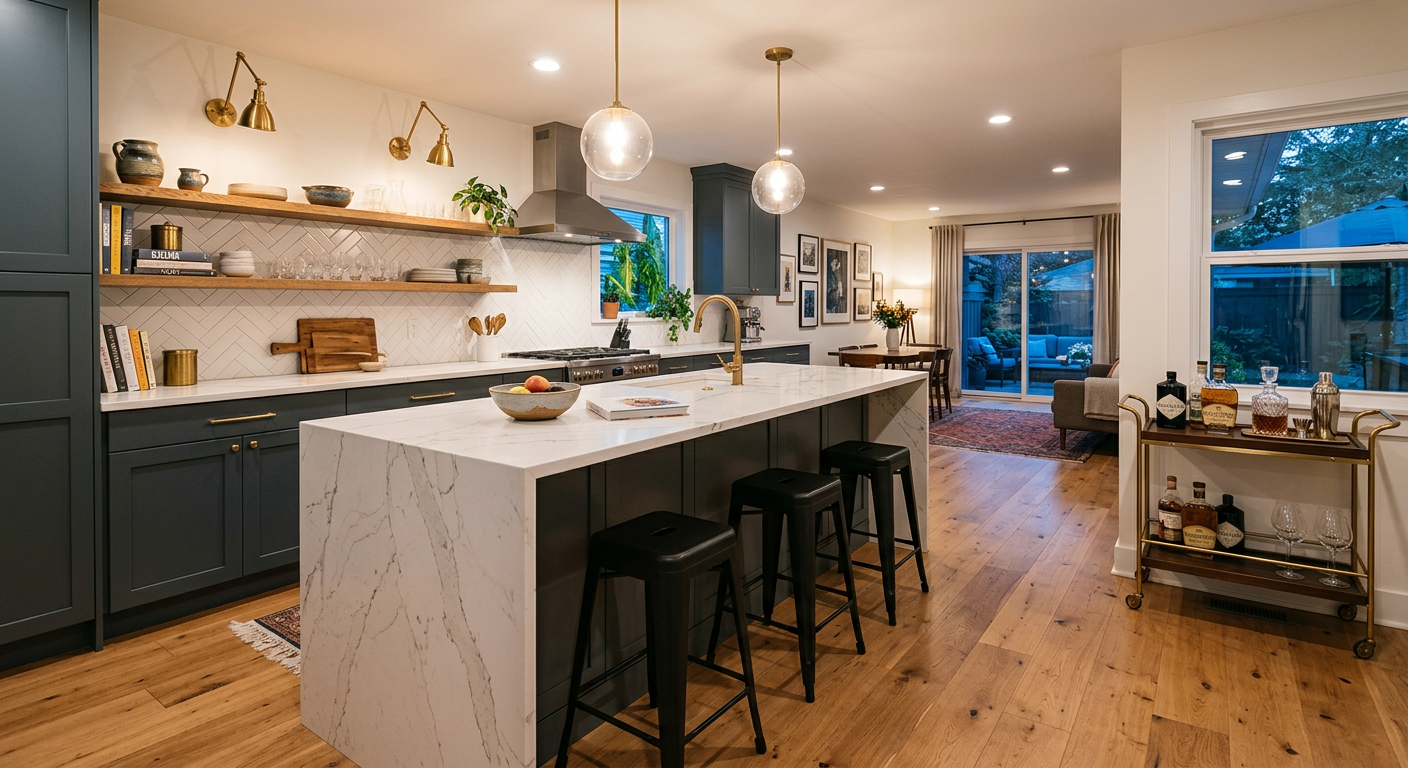
Island-centered. Any of the above with a central island. An island needs at least 36 inches of clearance on all sides to avoid feeling cramped. I wrote a full guide on kitchen island costs and planning.
Open concept. Removing a wall between the kitchen and living/dining area. This is the single most requested change I get. It opens up sightlines, lets families interact across rooms, and makes smaller homes feel bigger. But it requires structural evaluation first, because some of those walls are load-bearing. If yours is, you’ll need a beam to replace the wall, which adds $3,000 to $8,000. Read more about open concept kitchen remodel costs.
Cabinets
Cabinets set the visual tone and eat the biggest portion of your budget. Three options:
Stock cabinets ($100-$300 per linear foot installed). Off-the-shelf from Home Depot, Lowe’s, or similar. Limited sizes and styles. Good for budget-conscious projects where the existing layout stays the same.
Semi-custom ($200-$650 per linear foot installed). Brands like KraftMaid, Thomasville, or Bellmont Cabinet Co. in Sumner. More finish options, better construction, and some size modifications available. This is what I install on most mid-range projects.
Custom ($500-$1,200+ per linear foot installed). Built to your exact specifications by a cabinet shop. Any size, any material, any feature. Lead times of 6-12 weeks. Best for unusual kitchen shapes or very specific design requirements.
Countertops
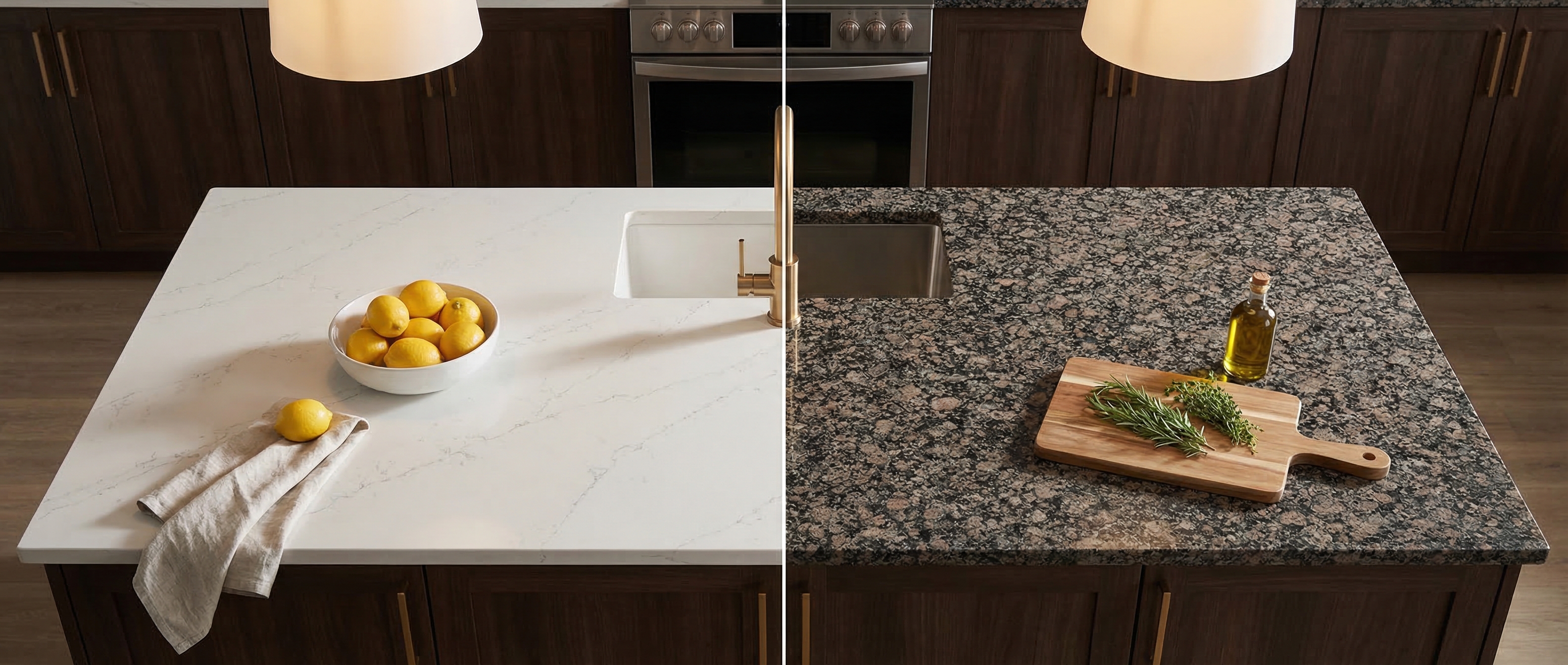
After cabinets, the countertop is the most visible surface in your kitchen. My recommendation for most Puyallup homeowners: quartz. It’s non-porous, doesn’t need sealing, resists stains and scratches, and comes in a huge range of colors including very convincing marble looks. Installed cost in Pierce County runs $50-$100 per square foot.
Granite runs similar pricing but requires annual sealing. Marble is beautiful but stains easily. Butcher block adds warmth as an island accent. For a full comparison, check out my post on quartz vs. granite countertops.
Flooring
Luxury vinyl plank (LVP) has taken over the kitchen flooring market in our area, and for good reason. It’s waterproof, durable, comfortable underfoot, and installs at $6-$12 per square foot. Tile runs $10-$20 per square foot installed and lasts longer but feels cold and hard. Hardwood looks great but doesn’t hold up well around the sink and dishwasher where water exposure is constant.
What to Expect During Construction
This is the part HGTV doesn’t show you. Those 30-minute episodes skip the hard reality: you’re living without a full kitchen for weeks. Here’s what the construction phase actually looks like.
Week 1: Demo. Everything old comes out. Cabinets, countertops, flooring, backsplash, sometimes walls. Your kitchen becomes a construction zone. Dust and noise are constant.
Week 2: Rough work. Plumbing, electrical, and any structural modifications. This is when inspectors visit to verify the work meets code. If your home is older, this is when we discover what’s hiding behind the walls. In the PNW, moisture damage and outdated wiring are the most common surprises.
Weeks 3-4: Cabinets and flooring. New cabinets go in first. They need to be level, plumb, and square. Every box gets shimmed individually. Then flooring goes down in the areas around the cabinets (or under them, depending on the flooring type).
Weeks 4-5: Countertops. The fabricator templates after the cabinets are installed, then returns 10-14 days later to install. This is a fixed waiting period. Nobody can rush it. The template has to be exact or the countertop won’t fit.
Week 5-6: Finishes. Backsplash tile, painting, hardware installation, appliance hookup, lighting, and trim. This is when the kitchen starts looking like a kitchen again.
Final: Punch list and walkthrough. I walk every project with the homeowner, noting anything that needs touch-up or adjustment. Cabinet doors that need alignment. Paint spots. Caulk lines. We fix everything before calling it done.
Surviving Without a Kitchen
Set up a temporary kitchen before demo starts. You’ll need:
- A microwave, toaster oven, and electric kettle on a folding table
- A utility sink or access to a bathroom sink for dish washing
- A mini fridge (borrow or rent one)
- Paper plates and disposable utensils to reduce cleanup
- A meal plan heavy on slow cooker recipes, takeout, and quick prep food
Most of my clients tell me the first week is rough, and then they adapt. Plan for it and it’s manageable. Don’t plan for it and you’ll be frustrated every day.
Working With a Contractor: What to Look For
I’m biased, obviously. But after 20+ years watching good and bad contractors work, I know what separates them. Here’s my honest advice for choosing the right person for your kitchen remodel.
Check the license. In Washington State, every contractor needs an active license through the Department of Labor and Industries. Look up their license number at lni.wa.gov. Pacific Remodeling’s license is PACIFRL814J4. Verify it. Verify every contractor you talk to. An unlicensed contractor means no bond, no insurance, and no recourse if things go wrong.
Get a detailed estimate. A one-page bid that says “kitchen remodel - $45,000” is a red flag. You should see line items for demo, cabinets, countertops, flooring, plumbing, electrical, permits, and everything else. The more detail, the fewer surprises. Compare the line items across your 3 bids and make sure everyone is bidding the same scope.
Ask about change order policy. Change orders happen. You’ll open a wall and find something unexpected, or you’ll change your mind about a fixture. A good contractor explains upfront how change orders are priced and documented. A bad one springs surprise invoices on you mid-project.
Look at their work. Not just photos on a website. Ask for addresses of completed projects you can drive by, or references you can call. Talk to past clients about the contractor’s communication, timeline accuracy, and how they handled problems. Problems happen on every project. What matters is how the contractor responds.
Communication matters more than you think. I answer my phone. I show up when I say I will. I keep clients updated throughout the project. That sounds basic, but if you’ve ever tried to get a contractor to call you back, you know it’s rare. During your initial consultations, pay attention to how quickly they respond and how clearly they explain things. That’s a preview of how the project will go.
PNW-Specific Considerations for Puyallup Kitchens
Living in the Pacific Northwest creates specific challenges I deal with on every project. If your contractor doesn’t mention these things, that’s a red flag.
Moisture behind walls. Our rain and humidity mean water damage behind walls is everywhere in older homes. I’ve pulled back drywall in homes that looked perfect from the outside and found black mold and rotted framing. During a kitchen remodel is your one chance to fix these issues properly. Skipping them means you’re just putting pretty cabinets over a ticking time bomb.
Ventilation. Proper range hood ventilation matters more here than in a dry climate. Cooking moisture plus PNW humidity creates conditions for mold if your kitchen doesn’t vent properly. I install ducted range hoods on every project because recirculating fans just push the moisture around.
Older home wiring. Many Puyallup homes built before 1970 have outdated electrical. When you touch the kitchen electrical during a remodel, you often need to bring it up to current code. That means GFCI outlets, proper circuit loads for modern appliances, and sometimes a panel upgrade. Budget $2,000-$5,000 for electrical upgrades in an older home.
Crawl space moisture. Pierce County homes with crawl spaces often have moisture issues underneath. If your kitchen floor feels cold or your subfloor shows signs of softness, we need to address what’s happening below before installing new flooring on top.
Material choices that handle our climate. I steer clients toward moisture-resistant materials whenever possible. Quartz over marble (marble is porous). LVP over hardwood in wet zones. Porcelain tile over natural stone in high-moisture areas. These choices reduce maintenance and last longer in our environment.
Your Kitchen Renovation Checklist
Before you call any contractor, run through this list:
- Define your kitchen’s biggest problems (layout, storage, appearance, appliances)
- Set a realistic budget including 15-20% contingency
- Decide if you want to keep the existing layout or change it
- Research at least 3 licensed contractors
- Create a folder of photos showing the style you want
- Measure your kitchen’s current dimensions
- List every appliance you want (including sizes)
- Plan where your family will eat during construction
- Check financing options (HELOC, personal loan, savings)
- Make a “must have vs. nice to have” priority list
The homeowners who walk into a consultation with this list completed save 2-3 weeks off their planning timeline. Indecision during the project is what causes delays and budget overruns. Know what you want before the first hammer swings.
Frequently Asked Questions
How long does a kitchen remodel take in Puyallup?
A cosmetic refresh takes 2-4 weeks. A mid-range remodel with new cabinets, countertops, and flooring takes 6-10 weeks of construction, plus 4-8 weeks of planning and material ordering before that. A full gut remodel with layout changes takes 10-16 weeks of construction. Add 2-4 weeks to any timeline if your home was built before 1970, because older homes almost always have surprises behind the walls that add scope.
How much should I spend on a kitchen remodel relative to my home value?
I tell clients to budget 5-15% of their home’s current value. For a typical Puyallup home valued at $500,000-$600,000, that puts the range at $25,000-$90,000. Going above 15% risks over-improving for your neighborhood. Going below 5% usually means a cosmetic refresh rather than a full remodel. For detailed ROI data, read my post on whether a kitchen remodel is worth the investment.
Do I need permits for a kitchen remodel in Puyallup?
Yes, if the project involves plumbing changes, electrical work, structural modifications (wall removal), or changes to the gas line. Cosmetic updates like painting, replacing countertops on existing cabinets, or swapping hardware don’t require permits. Your contractor should handle the permit process. In Puyallup, plan on $500-$1,500 in permit fees for a typical kitchen remodel.
Can I remodel my kitchen in stages to spread out the cost?
You can, but it costs more in total than doing everything at once. Every time a crew mobilizes, there’s a setup cost. If you separate the project into two phases, you’re paying for two rounds of demo prep, two rounds of cleanup, and potentially reworking things in phase two that were installed in phase one. That said, I’ve helped clients phase projects when the budget demanded it. The best split: do all rough work (plumbing, electrical, structural) in phase one, then finish surfaces (cabinets, countertops, backsplash) in phase two.
What’s the best time of year to remodel a kitchen in the PNW?
Kitchen remodels are interior projects, so weather matters less than it does for exterior work. That said, spring and early fall are the busiest seasons for contractors in Pierce County. If you want the best scheduling availability, plan for late fall or winter. You might also get slightly better pricing since it’s the slower season. Just make sure your contractor can keep the house sealed during demo if it’s raining, because an exposed kitchen wall during a November downpour creates problems fast.
What are some ideas for a smaller kitchen remodel?
If you’re working with a compact kitchen and a tighter budget, smart design choices make a bigger impact than square footage. I wrote a detailed guide on small kitchen remodel ideas for Puyallup homes that covers layout tricks, storage solutions, and which upgrades give you the most bang for your dollar in a smaller space.
Ready to Start Planning Your Kitchen?
I give every potential client a free, no-pressure consultation. I’ll walk through your kitchen, talk about your goals, and give you honest numbers for your specific project. No hard sell. Just straight answers from someone who has done this work for over two decades.
Call me at (253) 392-9266 or reach out through our contact page. I’ll get back to you within one business day.
Brad Zemke, Owner Pacific Remodeling LLC Puyallup, WA