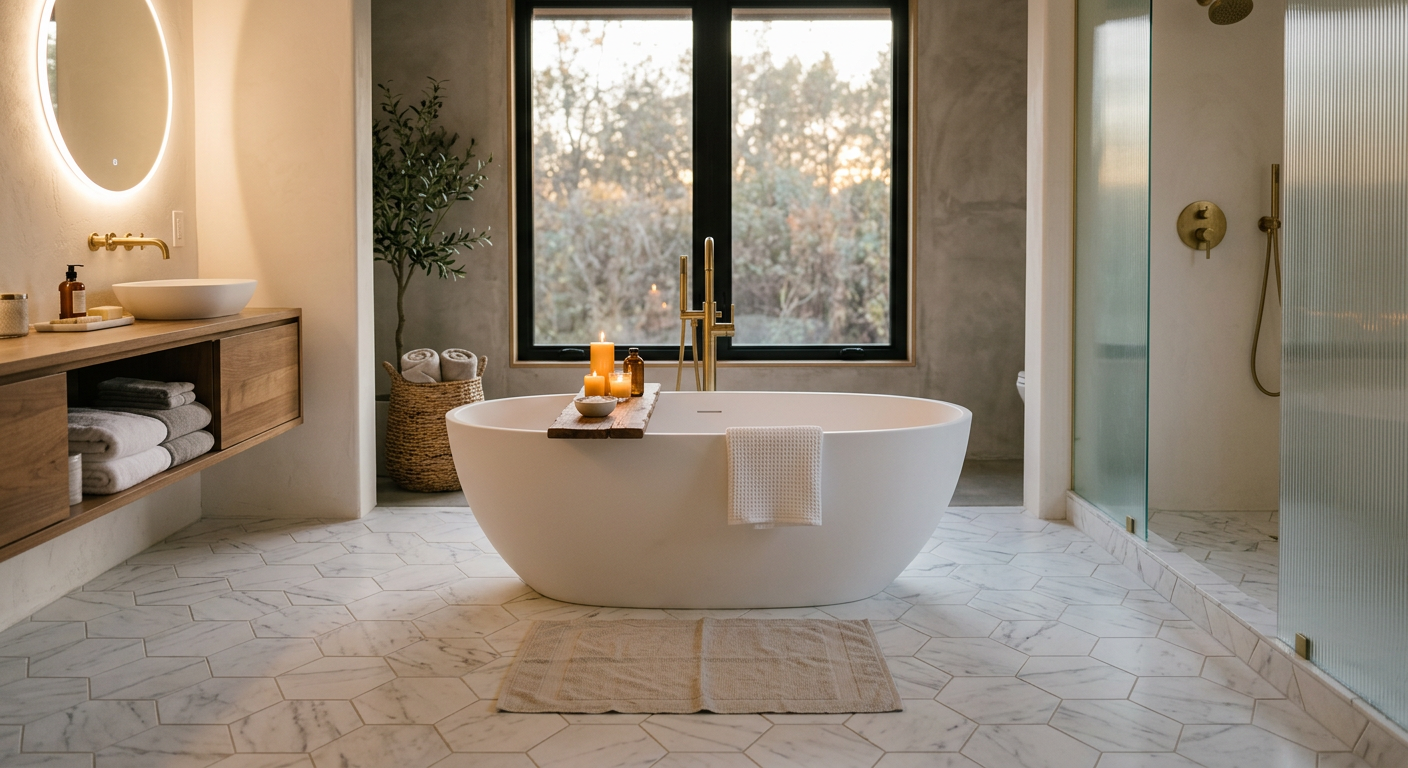
Every year I track what my clients ask for, and 2026 has brought a clear shift. The bathroom is no longer just a functional room people rush through in the morning. Homeowners in Puyallup and across Pierce County are treating the bathroom like a space worth investing in, and the trends reflect that. More comfort. More intentional design. More long-term thinking.
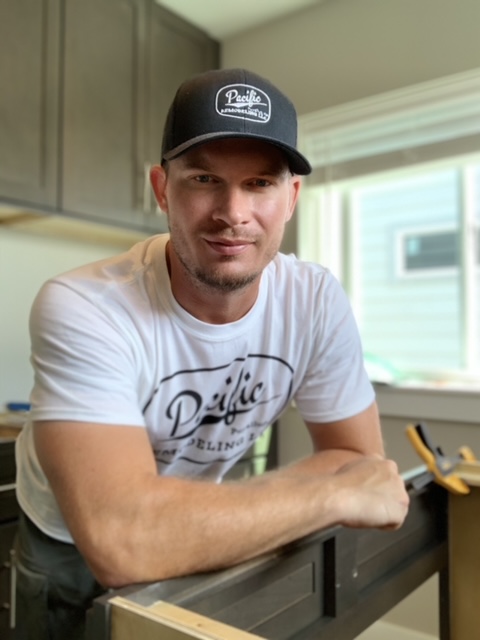
I’m Brad Zemke, owner of Pacific Remodeling in Puyallup. I’ve been in the trades for over 20 years and running this business since 2018. I remodel bathrooms every week, and I see firsthand what people want, what works, and what looks great in a showroom but falls apart in real life.
Here are the trends driving bathroom remodels across our projects in 2026, along with real costs and my honest take on each one.
1. Curbless Walk-In Showers
This is the single most requested feature in my bathroom remodels right now. About 65% of my master bathroom projects in 2026 include a curbless shower design.
A curbless (zero-threshold) shower eliminates the raised curb at the shower entry. The floor transitions smoothly from the bathroom into the shower with no step. The result is a shower that feels bigger, looks cleaner, and functions better for everyone from young kids to aging adults.
Why it’s popular: The open look makes bathrooms feel larger. It provides excellent accessibility without looking like a medical accommodation. And it photographs well for resale.
What it costs: A curbless shower adds $1,500-$3,000 to a standard shower build. The extra cost comes from the floor slope requirements (the entire bathroom floor must slope slightly toward the drain) and the waterproofing, which has to be more extensive since there’s no curb to contain water.
My honest take: I love curbless showers and recommend them for most master bathrooms. The one caveat: if your bathroom floor is concrete slab, the cost jumps because you need to cut into the slab to create the necessary drain slope. On a framed floor (most Pierce County homes), it’s straightforward. On a slab (some townhomes and condos), budget an extra $2,000-$4,000 for the slab work.
The drain matters. Curbless showers pair best with a linear drain along one wall instead of a center point drain. A linear drain allows a single-direction floor slope, which means you can use large-format tiles on the shower floor without cutting them into tiny wedge shapes. More on that next.
2. Large-Format Porcelain Tile
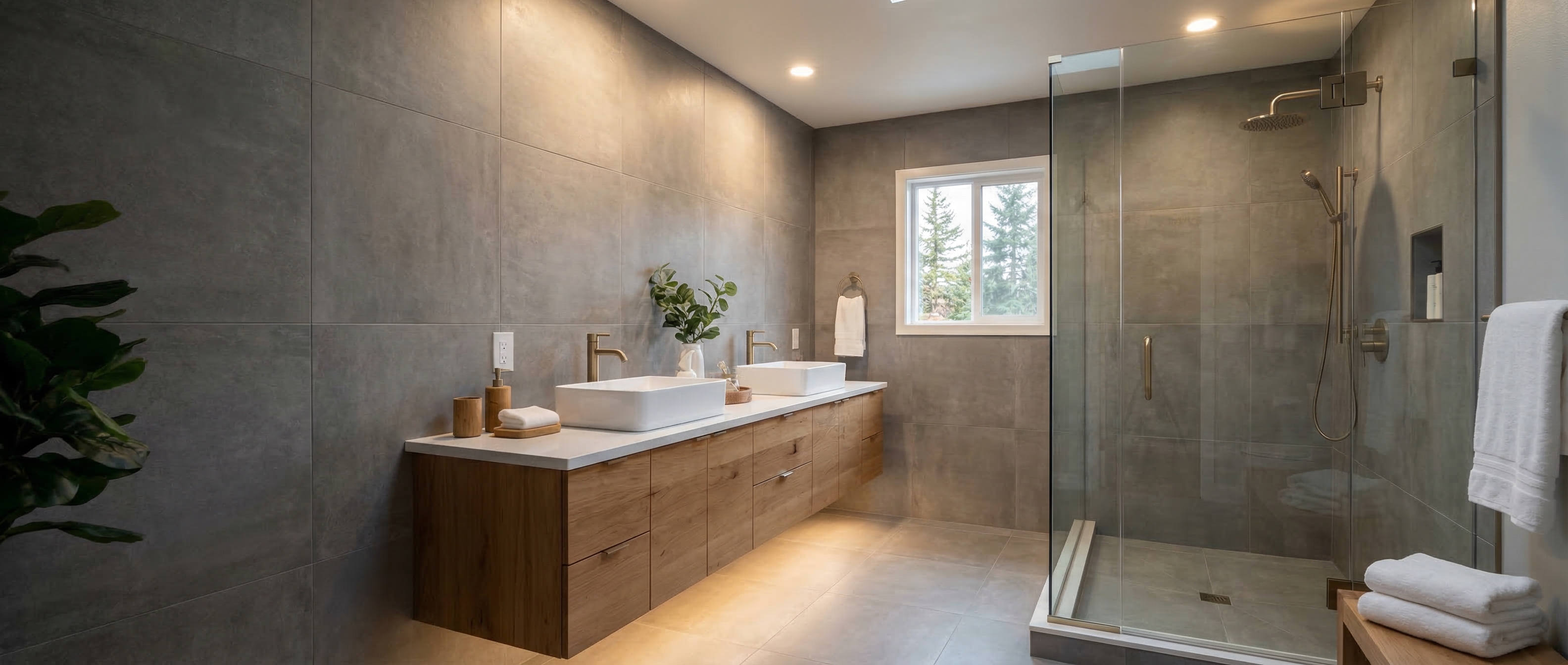
Bigger tiles mean fewer grout lines. Fewer grout lines mean a cleaner, more modern look and less maintenance. I’m installing 24”x48” and even 48”x48” porcelain tiles on shower walls and bathroom floors in 2026.
The most popular choice: marble-look porcelain. You get the veining and character of real marble without the sealing, staining, and etching problems. A full shower tiled in large-format porcelain looks like it belongs in a high-end hotel.
What it costs: Large-format porcelain tile runs $8-$20 per square foot for the material. Installation costs more than standard tile ($12-$18 per square foot) because the tiles are heavier, require more precision, and need specialized thin-set application. A typical shower with large-format tile runs $8,000-$15,000 total for tile and installation.
My honest take: The look is worth the extra cost. Grout maintenance is the number one complaint I hear from homeowners with older tile showers. Large-format tiles reduce grout lines by 60-70% compared to standard 12”x12” tile. In the PNW, where humidity accelerates grout mold, that’s a practical benefit, not just an aesthetic one.
One thing to know: large-format tile requires a perfectly flat substrate. If your walls aren’t flat, the installer needs to float them with mortar first, which adds $500-$1,500 to the job. A good installer handles this as part of the prep. A cheap installer skips it, and you end up with tiles that don’t sit flush.
3. Heated Tile Floors
In the Pacific Northwest, heated bathroom floors have moved from luxury to must-have. I install them on roughly 40% of my bathroom projects now, and that number keeps climbing.
The system is simple. An electric heating mat (Schluter Ditra-Heat, NuHeat, or SunTouch are the brands I use most) goes under the tile floor. A thermostat on the wall controls the temperature. You step out of the shower onto a warm floor instead of cold tile. On a December morning in Puyallup, that changes your entire day.
What it costs: The heating mat and thermostat run $800-$1,500 depending on bathroom size. Installation (including the dedicated electrical circuit) adds $500-$1,000. Total: $1,300-$2,500. The operating cost is about $0.25-$0.50 per day when set to a reasonable schedule.
My honest take: This is the best value upgrade you can put in a bathroom. For $1,500-$2,000 total, you get a feature you’ll use every single morning for the next 20+ years. That’s less than $0.30 per day over a 20-year life span. My clients who install heated floors say it’s the upgrade they’re happiest about. Every time.
For a bathroom remodel that costs $25,000-$40,000 total, adding $2,000 for heated floors is a no-brainer. I recommend it to everyone. For more on bathroom costs and what different upgrades run, check my bathroom remodel cost guide.
4. Floating Vanities
Wall-mounted vanities create visual space by revealing the floor beneath. The bathroom looks bigger because your eye can see more floor area. Cleaning is easier because you can sweep and mop under the vanity without obstruction.
Floating vanities work especially well in smaller bathrooms, which is most of what I remodel in Pierce County. A standard guest bathroom or hall bathroom in a Puyallup-area home runs 40-60 square feet. Every visual trick that makes the space feel larger is worth considering.
What it costs: A quality floating vanity with quartz countertop runs $1,200-$3,500 depending on width and material. Installation requires blocking in the wall for support (the vanity hangs from the wall studs, not the floor), which adds $200-$400 to the installation if the blocking isn’t already in place.
My honest take: Floating vanities look great and function well. The one limitation: they typically don’t have as much storage as a floor-mounted cabinet because the base area is open. If storage is tight, consider a floating vanity with deep drawers and pair it with a recessed medicine cabinet or wall-mounted storage tower.
5. Matte Black Fixtures
Matte black faucets, shower heads, towel bars, and hardware continue to dominate fixture requests in 2026. The high contrast against white or light tile creates a sophisticated look that photographs well and shows no water spots or fingerprints.
What it costs: A full set of matte black fixtures (shower valve, trim, rain head, handheld, faucet, towel bar set, robe hook, toilet paper holder) runs $1,200-$3,000 depending on the brand. Delta, Moen, and Kohler all offer full matte black collections. At the higher end, brands like Brizo and Grohe offer premium options.
My honest take: Matte black is not a passing trend. Brushed nickel dominated for 15 years before this. Chrome dominated for 20 years before that. Matte black has staying power because it works with almost every design style, from modern to farmhouse to transitional. I’ve been installing it for 4 years now and haven’t seen a single client regret the choice.
The one caution: matte black shows scratches more than chrome or brushed nickel. Buy quality fixtures from a brand that uses a durable finish (PVD coating is the gold standard). Cheap matte black fixtures from discount sources can start peeling or wearing within 2-3 years.
6. Linear Drains
The traditional center drain is being replaced by linear drains along the shower wall or entry. Linear drains work hand-in-hand with the curbless shower trend.
A linear drain sits flush with the tile along one wall of the shower. Instead of sloping the floor in four directions toward a center point, you slope in one direction toward the linear drain. This single-direction slope means you can use large-format floor tiles in the shower without cutting them into awkward shapes.
What it costs: A quality linear drain (Schluter Kerdi-Line, Infinity Drain, or QuickDrain) runs $400-$1,200 for the drain body and grate. Installation adds $300-$600. The total cost is $700-$1,800 compared to about $200-$400 for a standard center drain.
My honest take: If you’re doing a curbless shower with large-format tile, a linear drain is practically required. The aesthetic and functional benefits justify the cost. If you’re doing a standard shower with a curb and smaller tile, a center drain works fine and saves $500+.
7. Natural Materials and Earthy Tones
The all-white bathroom is giving way to warmer, more organic tones. I’m seeing more requests for:
Warm wood tones in vanities and shelving. Not actual wood in the wet areas (that’s a maintenance nightmare), but wood-look porcelain tile, wood-grain laminate vanity fronts, and floating wood shelves outside the splash zone.
Earthy tile colors. Sage green, warm taupe, soft terracotta, and cream are showing up in accent walls and shower niches. Not replacing white entirely, but adding warmth to the palette.
Natural stone accents. A stone-look porcelain feature wall behind the vanity or a natural pebble floor in the shower adds texture without the maintenance concerns of real stone.
What it costs: Earthy-toned tiles run similar to white tiles. The price difference is minimal. A warm-toned vanity might run $200-$500 more than a basic white one depending on the manufacturer. The overall project cost stays in the same range.
My honest take: I like this trend because it adds personality without being so specific that the next buyer hates it. Warm neutrals have broad appeal. Bright colors (turquoise, bright green, deep red) don’t. If you want to add character to your bathroom, warm earth tones are a safe way to do it.
8. Smart Bathroom Features
Technology in the bathroom is growing, but selectively. Not every smart feature makes sense. Here’s what I’m installing and what I’m not:
Worth it:
- Backlit mirrors ($400-$1,200): Clean look, built-in lighting, defogging feature. Eliminates the need for separate vanity light fixtures.
- Humidity-sensing exhaust fans ($200-$400): Turn on automatically when moisture rises and shut off when it drops. Essential in the PNW. No more forgetting to turn the fan on.
- Motion-sensor nightlights in the toe kick ($100-$300): Subtle, practical, and appreciated by everyone who uses the bathroom at 2 AM.
Skip it:
- Smart toilets with built-in bidets ($2,000-$5,000): Niche market. Most buyers in our area aren’t looking for this.
- Bluetooth shower speakers ($200-$600): Just use a waterproof speaker on the vanity. Built-in speakers become outdated quickly.
- TV mirrors ($1,500-$3,000+): Expensive, hard to service, and the technology changes faster than the mirror lasts.
9. Statement Lighting
Bathroom lighting is getting more intentional. The single overhead fixture is being replaced by layered lighting plans:
LED cove lighting along the ceiling or behind a floating vanity creates ambient warmth. Pendant lights or decorative sconces flanking the mirror add style and better face illumination than a light bar above the mirror. Recessed LED lighting in the shower provides clean, waterproof illumination.
What it costs: A full bathroom lighting plan with 2 vanity sconces, recessed shower light, cove lighting, and dimmer switches runs $1,500-$3,500 installed.
My honest take: Good lighting makes every other decision in the bathroom look better. It’s one of the most undervalued upgrades. A $30,000 bathroom with bad lighting looks like a $15,000 bathroom. A $20,000 bathroom with great lighting looks like a $35,000 bathroom. Always budget for lighting.
Which Trends Last and Which Fade?
Not every trend has staying power. Here’s my prediction based on 20+ years of watching design cycles:
| Trend | My Longevity Prediction | Why |
|---|---|---|
| Curbless showers | 15+ years | Functional and aesthetic benefits are permanent |
| Large-format tile | 15+ years | Less grout maintenance is always desirable |
| Heated floors | Permanent | Comfort never goes out of style |
| Floating vanities | 10-15 years | Clean look with real practical benefits |
| Matte black fixtures | 10-15 years | Strong versatility across design styles |
| Linear drains | 15+ years | Tied to curbless showers, which are here to stay |
| Earthy tones | 5-10 years | Color trends cycle, but warm neutrals are safe |
| Smart features | Varies | Practical ones last; tech gimmicks don’t |
My advice: invest heavily in the trends at the top of this table. They’re functional improvements that happen to look great, not fashion choices that happen to be functional. The best remodel decisions solve a real problem while looking current.
Frequently Asked Questions
What is the most popular bathroom trend for 2026?
Curbless walk-in showers are the single most requested feature in my bathroom remodels this year. About 65% of master bathroom projects I’m building include a curbless design. The combination of accessibility, clean aesthetics, and a spacious feel makes it popular across all age groups.
Are heated bathroom floors worth the cost?
Yes. At $1,300-$2,500 total, heated floors are the best value upgrade in a bathroom remodel. You’ll use the feature every morning for the next 20+ years. Operating cost is about $0.25-$0.50 per day. In the Pacific Northwest, where mornings are cold and damp for 8 months of the year, warm tile floors make a meaningful daily difference.
How much does a trendy bathroom remodel cost in Puyallup?
A mid-range bathroom remodel incorporating current trends (curbless shower, large-format tile, heated floors, matte black fixtures, floating vanity) runs $28,000-$45,000 in Pierce County. The trends themselves don’t add dramatic cost. Curbless entry adds $1,500-$3,000. Heated floors add $1,300-$2,500. Matte black fixtures cost roughly the same as brushed nickel. The bulk of the cost is the standard remodel work: demo, plumbing, waterproofing, tile, and installation.
Will matte black fixtures go out of style?
Not soon. Matte black has been the dominant fixture finish request for 4-5 years in our market and shows no signs of slowing. It works with modern, farmhouse, transitional, and industrial design styles. Chrome and brushed nickel each dominated for 15-20 years before being overtaken. I expect matte black to hold strong through the end of this decade at minimum.
What bathroom trends should I avoid?
Avoid anything that’s too specific to your personal taste if resale is a concern. Bright-colored tile (turquoise, bright green), overly themed designs, and expensive tech features that evolve quickly (TV mirrors, integrated smart home systems) tend to date faster and appeal to fewer buyers. Stick with functional improvements in neutral tones for the broadest appeal.
Ready to Bring These Trends to Your Bathroom?
If any of these trends have inspired your next project, contact Pacific Remodeling for a free consultation. I’ll walk through your bathroom, discuss which features make sense for your space and budget, and give you honest pricing.
Call me at (253) 392-9266 or reach out through our contact page. I’ll get back to you within one business day.
Brad Zemke, Owner Pacific Remodeling LLC Puyallup, WA